Product discovery is no longer a search engine problem. It's an agent problem.
When a customer asks ChatGPT for the best ski gloves or Gemini for a lightweight carry-on suitcase, they're not clicking through ten blue links. They're getting a direct recommendation. And increasingly, they're buying without ever visiting your website.
This is agentic commerce: AI assistants that can discover, evaluate, and transact on behalf of customers using standardized merchant capabilities.
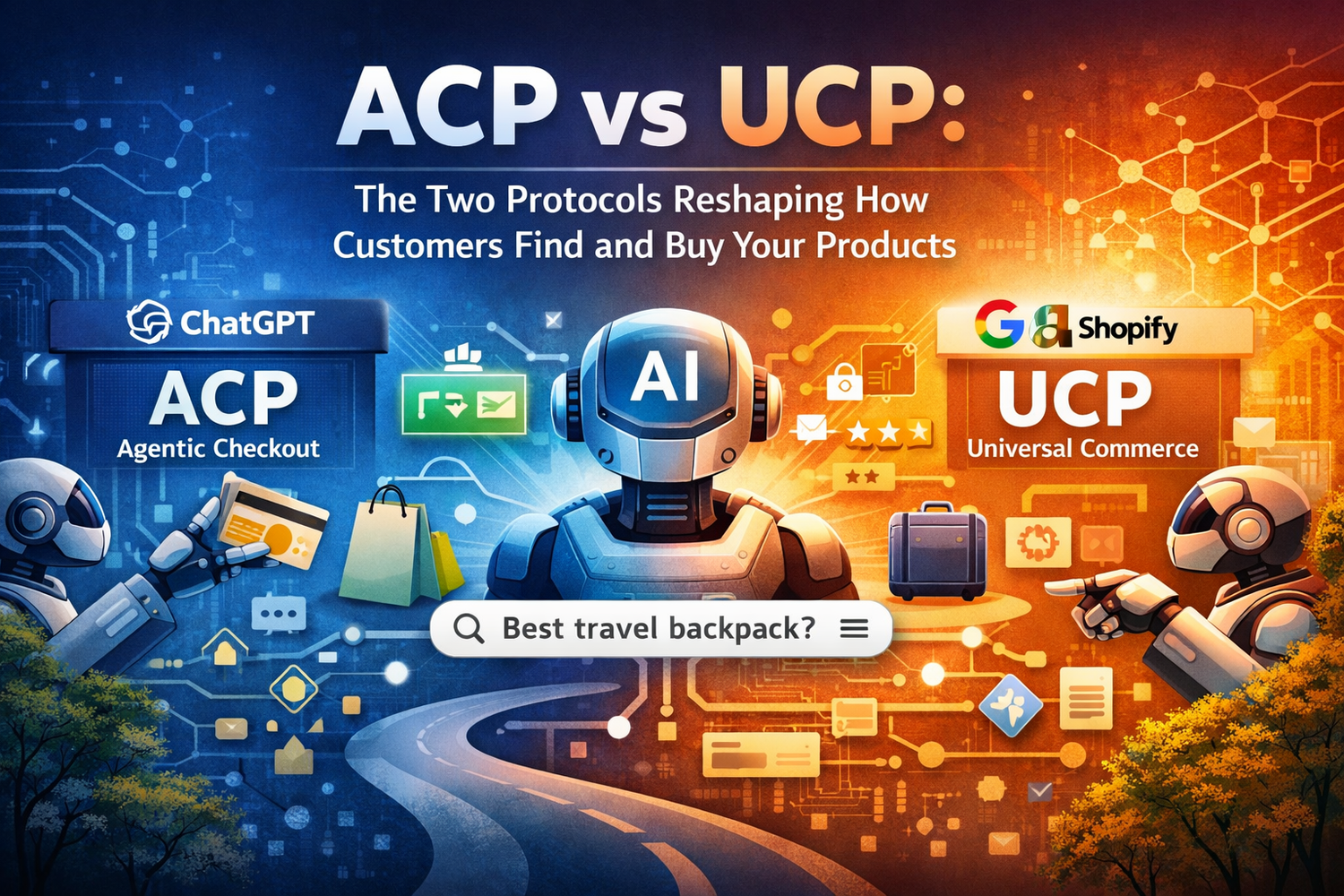
Two competing open standards now define how this works: the Agentic Commerce Protocol (ACP) from OpenAI and Stripe, and the Universal Commerce Protocol (UCP) from Google and Shopify.
The Mental Model
-
ACP = agent-native checkout rail (optimized for buying inside ChatGPT)
-
UCP = agent-native commerce language (optimized for shopping across any surface)
-
Discovery still decides winners
What is ACP (Agentic Commerce Protocol)?
ACP launched in September 2025 as a partnership between OpenAI and Stripe. It powers Instant Checkout in ChatGPT, allowing users to discover a product, ask questions, and complete a purchase without leaving the conversation.
The protocol is checkout-centric. It standardizes how AI agents communicate with merchants and payment providers to complete transactions. When a user saves their payment method in ChatGPT, the system creates a Shared Payment Token that can only be used with a specific merchant, has amount and time limits, and can be revoked at any time.
ACP is fast to implement. If you're already using Stripe, enabling ChatGPT Instant Checkout can take as little as one line of code. Shopify merchants were supported from day one, and platforms like Etsy, WooCommerce, and BigCommerce have followed.
The trade-off: ACP optimizes for a single-agent experience within OpenAI's ecosystem.
What is UCP (Universal Commerce Protocol)?
UCP launched in January 2026, co-developed by Google and Shopify and announced at NRF. It's backed by Walmart, Target, Etsy, Wayfair, and endorsed by over 20 partners including Visa, Mastercard, Stripe, and Adyen.
Where ACP focuses on checkout, UCP addresses the entire shopping journey: discovery, cart management, checkout, loyalty programs, post-purchase support. It establishes a common language for AI agents to communicate with merchants across any surface.
The architecture is modular. Merchants declare what capabilities they support, agents discover those capabilities, and transactions proceed through standardized APIs. UCP supports multiple transport methods: REST, Model Context Protocol (MCP), Agent2Agent (A2A), and Agent Payments Protocol (AP2).
UCP powers the new checkout experience in Google's AI Mode in Search and the Gemini app, with support for Google Pay and PayPal. Merchants remain the seller of record and retain full control over customer relationships.
The Key Differences
| Capability | ACP |
UCP |
|---|---|---|
Core function |
Standardized checkout + payment tokenization inside ChatGPT |
Standardized commerce capability language across agents |
Scope |
Transaction moment |
Full commerce lifecycle |
Architecture |
REST API tied to ChatGPT + Stripe rails |
Protocol-agnostic, multi-transport (REST, MCP, A2A) |
Payment model |
Stripe Shared Payment Token |
Modular Payment Handler (merchant declares, agent selects) |
Distribution |
Hundreds of millions of weekly ChatGPT users |
Billions of Google Search + Gemini users |
In practice, each protocol comes with a distribution gate. ACP requires onboarding through ChatGPT commerce. UCP commonly integrates via Google Merchant Center. These are product distribution policies, not protocol limitations, but they shape how merchants actually get discovered.
Decentralized Discovery: The Sleeper Feature
Here's something most coverage has missed.
UCP allows merchants to publish commerce capabilities at a /.well-known/ucp endpoint on their own domain. Any AI agent can theoretically discover and transact with UCP-enabled merchants without going through a central authority.
This is the closest thing we've seen to robots.txt for commerce agents. If you're not declaring structured capabilities, you may be invisible to agents that query outside of Google's ecosystem.
In practice, most merchants today still integrate through Merchant Center. But the architecture exists for a more open future where agents crawl merchant endpoints directly. Early movers who implement /.well-known/ucp now will be positioned when that shift happens.
The Real Competition: Product Discovery
Protocols don't win markets. Distribution does.
Checkout rails are increasingly commoditized. Discovery is not.
In agentic commerce, the buyer isn't browsing pages. The agent is ranking structured candidates. If your products aren't readable by agents, you won't make the shortlist.
We're seeing AI referral traffic increase significantly for merchants who have optimized for agent discovery. In some early-adopter categories, traffic from ChatGPT and Gemini is up 400-600% year over year, though from a small base. This traffic converts better than traditional organic because it arrives with higher intent. The AI already pre-qualified the recommendation.
But merchants who have not optimized for this new paradigm are experiencing the cannibalization without the replacement. Organic Google traffic is declining. AI-driven traffic is growing. The question is whether you're capturing both.
Agents care about things humans rarely see: return policy clarity, attribute completeness (size, weight, material, compatibility), real-time inventory accuracy, shipping speed, warranty terms, and consistent identifiers (GTIN, MPN, SKU). Missing or inconsistent data is not just a feed quality issue. It's an agent visibility issue.
If you do nothing else, ensure: GTIN/MPN completeness, shipping time accuracy, returns clarity, and variant-level inventory.
GEO: A New Layer, Not a Replacement
Generative Engine Optimization (GEO) is not just SEO with a different acronym.
GEO isn't replacing SEO. It's replacing some of what SEO used to do (demand capture) and moving it to model-mediated ranking systems.
AI models weight mentions in publications differently than Google weights backlinks. A brand mention in the Wall Street Journal without a link is useless for traditional SEO but valuable for GEO because LLMs treat authoritative sources as truth inputs. They prefer Q&A-formatted content that mirrors how users query agents. ChatGPT specifically uses Bing for hybrid search queries, which changes ranking priorities.
The merchants winning in agentic commerce are treating AI visibility as a distinct channel with its own optimization requirements, CAC benchmarks, and attribution models. Not as an extension of SEO or an afterthought to checkout.
Decision Framework for Merchants
"Enable both protocols" is directionally correct but lacks nuance. Here's how to prioritize:
If you're Shopify + Stripe: ACP is close to free upside. Enable ChatGPT Instant Checkout first, then add UCP through Agentic Storefronts. You can manage both from a single admin.
If you're Shopify (non-Stripe payments): Prioritize UCP and Google integration, then evaluate ACP if contribution margin allows the Stripe dependency.
If you're custom or headless: Pick the protocol aligned to your highest-traffic AI channel (ChatGPT vs Google), build a clean implementation, then expand. Consider an abstraction layer if you're building for both.
If you're on legacy platforms (Magento, Salesforce Commerce Cloud): This increases the ROI of migration. The protocol integrations are coming to legacy platforms, but they're coming slower and with more friction than Shopify.
The 4% Fee: How to Think About It
ChatGPT Instant Checkout charges a 4% referral fee on top of standard Shopify and Stripe fees. This has scared some merchants.
Think about it differently. Treat it like marketplace CAC. Compare 4% to your blended paid acquisition cost, then factor the higher intent rate and conversion lift. If your current CAC on Meta or Google Ads is 15-20% of AOV, 4% for a high-intent, pre-qualified buyer is favorable unit economics.
The merchants who should worry are those with already-thin contribution margins or heavy promotional calendars where stacking fees erodes profitability. For most DTC brands, this is a channel expansion play, not a margin compression problem.
Google's UCP fee structure is still emerging. Assume they'll monetize distribution, not protocol access. Monitor it, but don't let fee uncertainty delay implementation.
What Shopify Merchants Should Do Now
Audit your product data. Both protocols rely on structured data to represent your products to AI agents. Check attribute completeness, inventory accuracy, and identifier consistency. Missing GTIN or inconsistent sizing data costs you agent visibility.
Enable Agentic Storefronts. Manage presence across ChatGPT, Microsoft Copilot, Google AI Mode, and Gemini from one interface. Same products, different surfaces, unified management.
Test agent perception before and after. Ask ChatGPT and Gemini about products in your category. Note whether your brand surfaces, how it's described, and what's missing. Enable agentic commerce features, then compare.
Build attribution for AI channels. Track AI agent referral traffic as a distinct channel. Measure conversion rate, AOV, refund rate, and LTV against your other channels. This data will inform where to invest.
Model the economics. Calculate what 4% (or whatever Google lands on) means for your contribution margin at different AOV levels. Know your breakeven before you scale.
The Bottom Line
ACP and UCP represent different philosophies from companies with different business models. ACP is infrastructure-first, built by OpenAI and Stripe to power transactions within ChatGPT. UCP is ecosystem-first, built by Google and Shopify to standardize commerce across any agent surface.
Neither will disappear. The question is not which protocol wins. The question is whether your products are discoverable when customers ask AI agents what to buy.
Shopify merchants have a structural advantage: tight integration with both protocols, Agentic Storefronts for unified management, and early access to features like Google's Direct Offers. But platform choice alone is not enough.
The brands that succeed in agentic commerce will be the ones that understand this is a new channel requiring new optimization strategies, new attribution models, and new unit economics thinking.
When a customer asks an AI agent for the best product in your category, are you the answer?