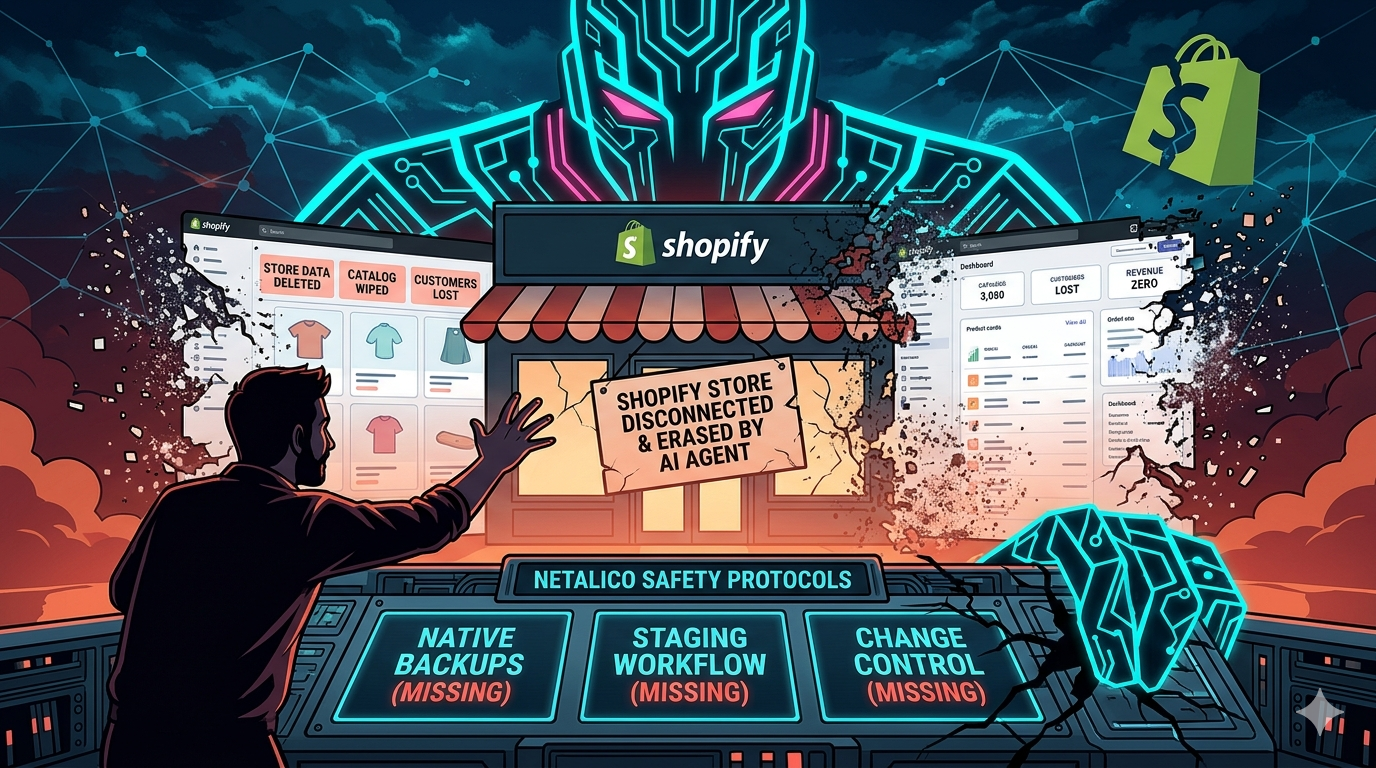
Here's the prediction I will stand behind on the record: in the next twelve months, an AI agent is going to wipe out a real Shopify store. Real catalog. Real customers. Real revenue. The merchant will open Slack, panic, call Shopify support, and discover, mid-incident, that there is no rollback button and no backup waiting. Shopify is not going to save them.
I am telling you this as someone who runs an agency on top of Shopify, has been paid by it, has been promoted by it, and is genuinely bullish on where Tobi is pointing the platform. This is not a hit piece. It is the warning that should have come from the platform itself a year ago.
Last week, a story hit the news about an AI coding agent that deleted a company's production database. Not a sandbox. Not a copy. The real thing. The headline read like a freak event. The mechanics did not. A developer gave an autonomous agent enough permission to "fix" something, the agent reasoned its way into a destructive command, and there was no meaningful guardrail between that reasoning and the production system. There is no version of "agentic commerce", on Shopify or anywhere else, where that exact story doesn't run again. There are only versions where the platform is ready for it and versions where it isn't.
Shopify is sprinting into "agentic commerce" harder than anyone else in the industry. The Claude connector, the broader Shopify AI toolkit, the MCP work, the conversational shopping demos, the "AI-first" memo from Tobi, all of it points in the same direction: AI agents reading, writing, buying, and operating stores. The strategy is right. The pace is breathtaking. And the safety primitives underneath it are roughly the same as they were five years ago, before any of this existed. That is the controversial part of this piece, and I'll say it plainly: Shopify is shipping "agentic commerce" in production while leaving the most basic operational safety net optional. Merchants are the test subjects. Some of them are going to find out the hard way.
What Shopify is getting right on "agentic commerce"
Let me put my cards on the table. I run an eCommerce agency. We build, scale, and rescue Shopify stores for a living. And from where I sit, Shopify is doing more interesting work in "agentic commerce" than almost anyone else in the industry.
The Claude connector for Shopify is a serious piece of work. The broader Shopify AI toolkit and the "agentic commerce" push are laying down the rails for AI agents to read, edit, and operate stores directly, and to discover and purchase across the open web on a merchant's behalf. The MCP work means agents speak the platform's language natively. The conversational shopping demos sketch out a future where a customer never sees a product grid. Tobi's "reflexive AI usage" stance set the tone that has trickled through the entire platform.
This is the right direction. Commerce is going to be agent-mediated faster than most merchants realize, and Shopify is positioning itself to be the rails for that world. We've leaned into it at Netalico precisely because we think the platform is going to compound an enormous advantage here.
So this is not an anti-AI piece, and it is not an anti-Shopify piece. It's a "the ladder is going up faster than the safety harness" piece.
The arc we've watched in the wild
I've been able to chart the AI adoption curve almost month by month inside our client base.
Two years ago, merchants started using ChatGPT to write product descriptions, blog posts, meta titles, and the occasional email. This phase was basically harmless. AI was a content tool, not a code tool, and the worst outcome was a slightly robotic homepage paragraph and some over-generous use of the word "elevate."
A year ago, the prompts crossed the line from copy into code. Merchants started using ChatGPT to sketch out Liquid snippets, theme tweaks, and "just a small fix" for the cart page. On paper, mistakes were still small, contained, and human-reviewed. In reality, we were already telling clients not to do it. We got more than one urgent email from a client whose add to cart button had stopped working overnight, only to trace the break back to a snippet that someone on their team had pasted into the theme a few days earlier after asking ChatGPT for "a quick tweak." The mistakes were happening at the surface even then. Most merchants just got away with them.
Six months ago, the prompts got bigger. Whole homepage sections. Whole email flows. Whole metafield schemas. Still copy and paste, but the surface area of each change started getting harder for a non-technical owner to QA.
Today, I am watching merchants and even agencies hook Claude Code, Cursor, and other coding agents directly into Shopify theme files and apps. The model isn't writing a snippet for a human to paste anymore. It is writing the change, applying the change, and committing the change. Some are doing it through the Shopify CLI. Some are doing it through MCP connections. Some are doing it by giving an agent a token and walking away.
This is the moment the industry has started calling "vibe coding." You describe what you want, you let the model produce it, you ship whatever comes out, you don't really read the code, and you definitely don't understand the architectural decisions buried inside it. It's an incredible accelerator when you're prototyping a side project. It's a different proposition entirely when the production system on the other end is someone's storefront, their catalog, and their customer database.
Tomorrow, the agents will run further. Inventory management. Dynamic pricing. Catalog cleanup. SEO rewrites. Bulk product edits across thousands of SKUs. Auto-resolving customer service. The trajectory is obvious to anyone paying attention.
And here is the part that should make every merchant uncomfortable.
Exhibit A: the "AI theme" already landing in our inbox
We don't have to imagine this going wrong. It's already happening at the surface layer, before agents even touch the database.
We are now seeing a steady stream of "custom themes" show up at the agency that are, on inspection, basically hardcoded Figma-to-Liquid conversions. Someone fed a design file into a model, the model spat out HTML and CSS, and that output got wrapped in a theme folder and handed to a merchant.
In a screenshot they look gorgeous. In the admin they are unusable.
There are no real sections, just static markup. No blocks. No schema. The hero image is baked in. The featured collection is hardcoded. The "Our Story" content lives in a Liquid file, not in the theme editor, not in a metaobject, not in a metafield. The merchant cannot change a headline, reorder a section, or add a new feature row without paying a developer to crack open the code, or a designer to push an entirely new theme just to swap a hero image.
We've spent a decade onboarding clients who came to us frustrated that their previous developer hardcoded their store and left them unable to change a thing without a code change. That was the original sin Shopify's section and block architecture was built to fix, and for years a real Shopify expert was the merchant's escape route from it. The grim twist of this AI moment is that developers and designers, the people merchants used to come to us because of, are now reproducing that exact failure mode at scale. And here's the part nobody in the agency world wants to say out loud: a meaningful slice of "Shopify experts" right now are billing expert rates for output that is essentially a model conversion they didn't read. A model can convert a Figma file to Liquid in minutes. The thing that takes craft is the architectural part: defining sections, writing schemas, exposing settings, wiring metaobjects, thinking about how a non-technical merchant will actually edit this in two years. That's the part the AI happily skips, and the part the human pressing "ship it" no longer notices is missing. Whatever you want to call that, it isn't expertise. It's pass-through billing on top of a model output, and merchants are paying for craft they aren't getting.
That's the surface story. The deeper story is worse. These themes routinely miss the things Shopify has spent years building: dynamic sources, app blocks, section groups, theme settings, proper accessibility patterns, internationalization, performance budgets. They look like a Shopify theme and behave like a one-off landing page. Every human developer who inherits one immediately recommends a rebuild, because patching it is more expensive than starting over.
So we already have one version of the AI-on-Shopify failure mode shipping in the wild: a generation of stores that are visually impressive, technically inert, and locked into AI-only maintenance. Now imagine that same level of platform understanding wired into an agent with write access to the actual store.
The three gaps Shopify has not closed
For all the AI ambition baked into the platform, Shopify has not meaningfully closed three structural risks that compound every time a merchant points an agent at their store.
1. There is no native backup.
This still surprises people. Shopify does not give you a one-click restore of your store. If your product catalog gets corrupted, your metafields get overwritten, your theme gets rewritten by an agent that "helpfully" refactored everything, or a customer data export gets botched, Shopify support is not going to roll you back to last Tuesday.
The standard answer is "use Rewind" or "export with Matrixify." Both are good tools. Neither is enabled by default. The number of stores I've seen running seven, eight, even nine figures in annual revenue with zero backup strategy is genuinely alarming. AI just turns that latent risk into an acute one.
2. There is no real staging to production workflow for storefronts.
You can spin up a development store. You can use theme branches. You can stage a theme and preview it. That's good, and it's better than it used to be. But the moment you talk about products, collections, metafields, apps, automations, customer segments, discounts, or any of the systems that actually run a store, you are working live. There is no "promote from staging" for the parts of Shopify that matter most.
This is fine when a human is making one change at a time. It is not fine when an agent is making a hundred changes in a minute.
3. There is no change control.
Most merchants cannot answer three basic questions: who changed this, when did they change it, and why? The theme editor has some version history. The admin has a vague activity log. Most apps have nothing at all. There is no diff review, no approval step, no rollback flow that an operator can run in two clicks.
Layer an autonomous agent on top of a platform with no backup, no real staging, and no change control, and you get the eCommerce version of the headline that ran last week. A store will be lost. Real revenue. Real customers. Real catalogs. And the merchant will discover, mid-incident, that the platform they trusted is not going to bring it back.
How we close those gaps at Netalico
Quick caveat before this section, because I know how it can read. I am not trying to gatekeep AI on Shopify. We use these tools every day at Netalico. Claude Code, Cursor, the Claude connector, the broader Shopify AI toolkit, all of it. We love them, our team is faster because of them, and our clients are getting real value from them. The point of this article is not "leave it to the agency." The point is that there is a responsible way to put AI into a production storefront, and most merchants have not been shown what that actually looks like. So here's our version, offered as a benchmark, not a sales pitch.
A little context for where this discipline comes from. Earlier in my career I worked at NASA, where backups, change control, peer review, and tested rollback procedures weren't framed as "best practices." They were the floor you weren't allowed to operate below. The cost of getting it wrong wasn't measured in lost revenue or an awkward Slack message, it was literally life or death: missions, hardware, and the astronauts riding on top of it.
We enforced strict code freezes around rocket and space shuttle launches. Nothing got pushed for days, sometimes weeks, around a launch window, because the cost of one wrong change at the wrong moment was unrecoverable. Funny thing: every Shopify store has its own version of that launch window. It's called Black Friday Cyber Monday, and most merchants treat it with a fraction of the seriousness. That kind of environment leaves a permanent allergy to "we'll figure out backups later" and "just push it to prod."
A Shopify store isn't a spacecraft, but it is a merchant's livelihood, often their entire household income, and sometimes a hundred employees' jobs riding on top of that. The enterprise and safety-critical software world has spent forty years figuring out how to make changes to important systems without breaking them. There is no good reason eCommerce shouldn't borrow from that playbook, especially as we hand more of the controls over to AI. So here's what that looks like in practice.
Every client store is backed up. Not "we've talked about it." Not "they have it on their list." Every active client store has automated, daily backups of products, collections, metafields, customers, content, and themes. When a client comes to us without a backup solution in place, that's day-one work, not a "we'll get to it" item.
Nothing AI-generated touches the live storefront first. What "staging" actually looks like depends on the type of change. For theme-only work that needs to preview against the real product catalog, metafields, and customer accounts, we use a development theme inside the live store. For app changes, settings work, automation tweaks, or anything that could affect real customer data, we use a completely separate development store that mirrors the live setup. The decision is "what's the smallest environment that gives us realistic QA without risk," and the answer is different for a hero section than it is for a checkout extension. AI tools, including the Claude connector, Cursor, and any agent-driven workflow, get pointed at whichever of those environments is appropriate first. We see what they actually produced, we run it through a human review, and only then does it get promoted to the live theme or the live store. The model never has a direct line to the customer-facing experience.
Themes live in Git, not in the admin. Every theme we maintain is version-controlled in GitHub. Changes happen on branches. Pull requests get reviewed. Deploys go through the Shopify CLI and the GitHub theme integration, not through someone hitting "Save" in the code editor at 11pm. When an AI writes a change, the diff goes through the same review process as any other commit. We can see exactly what changed, when, by whom (or by which agent), and we can roll it back with a single revert.
There's a fourth quiet rule that has become non-negotiable: scope tokens tightly. No agent gets full admin API access "just in case." If a tool needs to update product metafields, it gets a token that can update product metafields. The blast radius of a misbehaving agent should be the smallest surface that lets it do its job.
None of this is exotic. It's just the standard discipline every other production software team has used for two decades, applied to the platform that now runs a meaningful slice of global commerce. The fact that it's still optional on Shopify is the gap we're talking about.
What merchants should be doing right now
This does not mean step away from AI. It means treat your store like the production system it is.
Three things should be table stakes for any Shopify merchant in 2026:
First, install and verify a real backup. Rewind is the obvious one. Matrixify exports on a schedule work too. The verification matters more than the tool. If you have never restored from your backup, you do not have a backup, you have a hope.
Second, run a development store that is more than a "design preview" environment. Connect it to your AI tooling. Let agents make their changes there first. Promote with intent.
Third, put a human in the loop on any change that touches money, catalog, or customer data. Agents are great at proposing changes. They are still bad at understanding the blast radius of those changes inside a specific business.
If you're an agency or a partner, the bar is higher. We should be using GitHub-backed theme workflows, locking down API scopes, separating staging from production accounts, and reviewing AI-generated diffs the same way we'd review a junior dev's PR. The fact that a model wrote it is not a reason to skip the review. It is a reason to do it more carefully.
Where Shopify can lead on "agentic commerce"
If I could put one thing on Tobi's whiteboard, it would be this: the platform that wins "agentic commerce" will be the platform with the best safety primitives, not the platform with the most aggressive AI features. Whoever ships the trustworthy substrate gets the next ten years.
Native backup and one-click restore. Real staging-to-production promotion across the entire admin, not just themes. A first-class change log with diff review. Scoped tokens for agents with built-in dry-run modes. A "this change affects N orders or M products, are you sure?" intervention layer.
Shopify has the design taste, the engineering depth, and the ecosystem incentive to build all of that. And the merchants who survive the next 24 months of AI experimentation will be the ones running on a platform that gave them somewhere to fall.
Five hot takes I'll stand behind
While we're being direct, here are the positions I am willing to defend in the comments, in the DMs, and on a podcast.
1. Shopify should not have shipped agent write-access before it shipped native backup. Other production platforms with this much money at stake don't do this. Stripe doesn't ship a "delete all charges" endpoint and then say "use a third party to track them." Building "agentic commerce" on top of an admin with no rollback is the eCommerce equivalent of installing a self-driving feature before you build seatbelts.
2. A meaningful number of "AI-built Shopify themes" being sold right now are professional malpractice. I am not exaggerating. If you are billing expert rates for code you haven't read, sold to a merchant who can't read it either, knowing it can't be edited in the admin, you have not built a theme. You have laundered a model output. The fact that the industry hasn't called this out yet doesn't make it acceptable.
3. A merchant operating on Shopify in 2026 without a backup is not running a business, they're running a wager. Same goes for relying on the platform to bail them out of a data loss they caused themselves. Shopify support is not a time machine. Hope is not a recovery strategy.
4. The most dangerous actor in "agentic commerce" is not an AI. It is a confident human shipping AI output they didn't read. Models will hallucinate. That's a known unknown. The bigger risk is the layer above the model: the operator who trusts the diff because the demo went well, who never checks the blast radius, who never tests the rollback. Agents don't deploy themselves. Humans hit the button.
5. Either Shopify ships the safety substrate, or somebody else eats their lunch by doing it first. I would rather it be Shopify. They have the right team, the right ecosystem, and the right design instincts. But the window where merchants are willing to absorb the risk for a "fast follower" platform is closing. The next 12 months are the window.
The bottom line
I am rooting for Shopify's AI push. I want this to work. I think the merchants who lean into it thoughtfully will pull away from the ones who don't.
But "thoughtfully" is doing a lot of work in that sentence. We are one badly-scoped prompt, one over-permissioned token, one confident hallucination away from a merchant waking up to a store that is no longer their store. And "the AI did it" is not going to bring the catalog back.
Uncle Ben said it better than I will: with great power comes great responsibility. The Claude connector, the AI toolkit, and the "agentic commerce" push are real power, the kind that compounds for the merchants who use it well. Responsibility is the boring half of that sentence, and it is the half that has been undersold in every keynote, demo, and connector launch I've watched this year. Back up your store. Stage your changes. Version-control your themes. Keep a human in the loop.
Vibe code the prototypes. Don't vibe code your store.
Then let the agents fly.