The LLM channel is bigger than your dashboard says. A fairer scorecard for the answer engine and generative engine optimization work that makes it pay.
A True Story
A few weeks ago I was in ChatGPT, looking for a specific product. Up popped one of our clients. The recommendation felt earned, and I bought the thing on the spot.
On Amazon. Because it was cheaper, faster, and already linked to my Prime account.
Their LLM presence showed up. Their content did its job. The conversion happened. Not a line on their Shopify dashboard would ever know.
That is the entire ROI problem with agentic commerce in one transaction.
What Is Agentic Commerce?
Agentic commerce is the slice of eCommerce where AI agents do the shopping work on a buyer’s behalf. The agent interprets intent, evaluates options, and sometimes completes the purchase. ChatGPT recommending a product, Perplexity surfacing your pricing, and Google AI Overviews citing your product page are all agentic commerce in practice. You may also see it called agentic shopping, AI shopping, or AI search.
The work of getting your brand surfaced inside those AI answers goes by a few names. Answer engine optimization (AEO) and generative engine optimization (GEO) are the two most common. You will also see it called LLM optimization or LLM SEO. Whatever you call it, this article is about why brands underestimate what that work is worth.
Why the LLM Channel Numbers Look So Strong
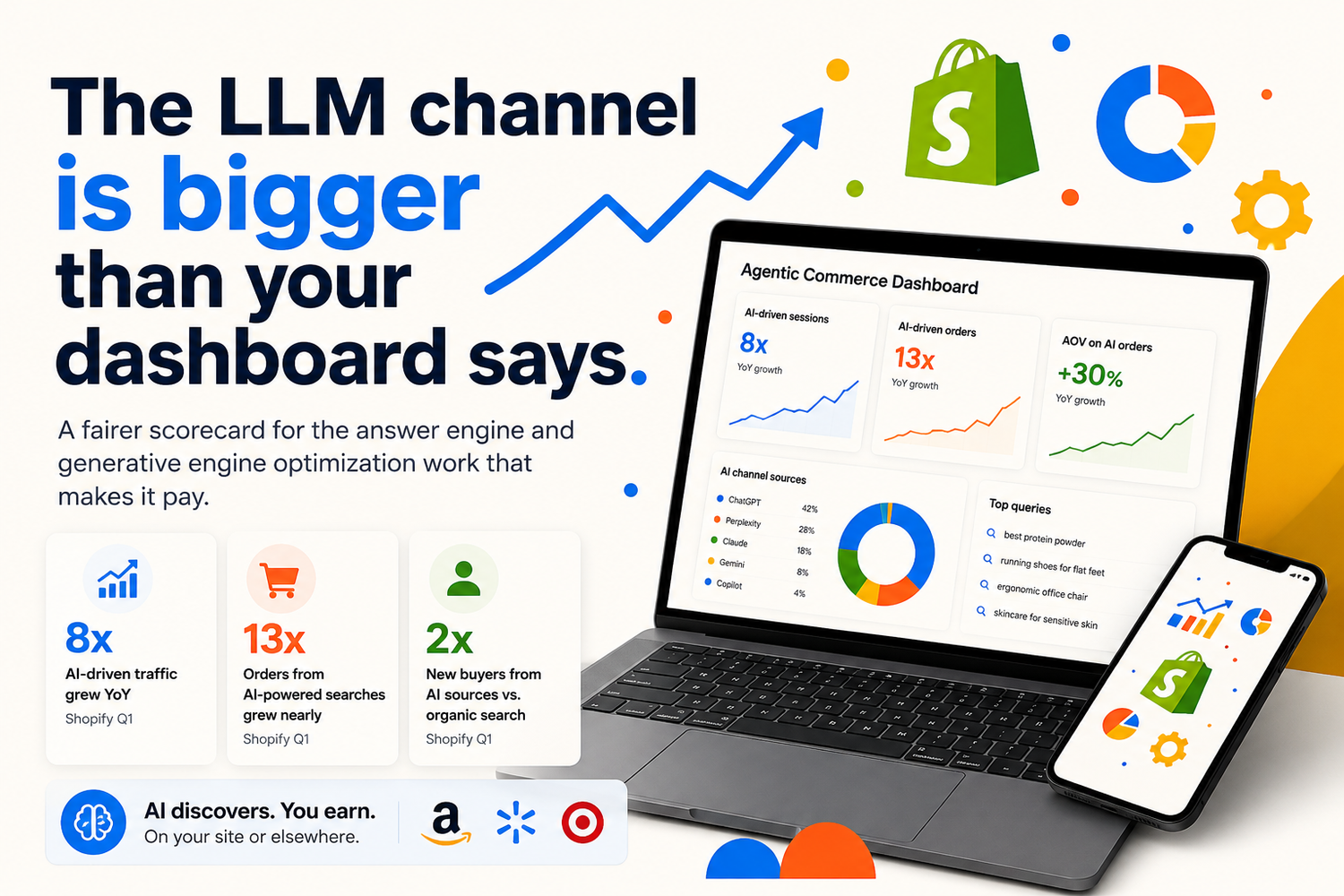
Shopify’s agentic commerce dashboard tells a striking story. AI-driven traffic grew 8x year over year in Q1. Orders from AI-powered searches grew nearly 13x. Average order value on agent-driven orders is up 30%. New buyers from AI sources arrive at almost twice the rate of traditional organic search.
Other research stacks on top. ChatGPT referrals convert 31% higher than non-branded organic. Across 94 eCommerce brands tracked in 2025, ChatGPT sessions grew more than 1,000%.
Those numbers are real. The AI pre-sells, and the customer arrives ready to buy. The numbers also miss almost everything that happens off platform. For omni-channel brands, that is where most of the money sits.
The Two Attribution Leaks in Agentic Commerce
Two places agentic commerce ROI is disappearing today. Both are sizeable. Neither shows up cleanly on a standard dashboard.
Leak 1: Stripped Referrers and Dark Direct Traffic
Even when an LLM sends a shopper to your store, your analytics often will not know they came from an LLM.
Free ChatGPT strips the referrer on inline links. The ChatGPT, Claude, and Perplexity mobile apps strip the Referer header before the browser loads your site. Copy and paste loses the source by default. A Clickport analysis of nearly 450,000 AI-adjacent visits found that more than 70% arrived with no referrer header and landed in GA4 as Direct.
Then there is the brand-name search. A shopper reads about your product in an LLM, does not click, and types your brand into Google. Claude in particular shows sources as numbered citations rather than rich product cards, which nudges users to look you up manually. That follow-up visit gets credited to branded organic.
Chip away at it with a custom AI channel group in GA4. Watch your branded search trend alongside your LLM visibility. Accept that some slice of your Direct and Branded Organic is LLM traffic in disguise.
Leak 2: Marketplace Bleed
This one is bigger. Fospha studied hundreds of retail brands and found that 40% of Amazon revenue is influenced by paid media that runs outside Amazon. Unified ROAS, which counts revenue a channel drives across every storefront, averages 45% higher than DTC-only ROAS. For TikTok upper-funnel, it climbs to 80% higher.
The same pattern applies to AEO and GEO work. The AI surfaces the brand. The shopper buys wherever is easiest. The original storefront gets no credit. Last-click ROI will undersell the investment. The question is how much, and what to do about it.
Is Agentic Checkout a Third Leak?
No. Most of the agentic commerce coverage assumes shoppers are already checking out inside ChatGPT through a commerce API. They are not, at any meaningful volume. OpenAI launched Instant Checkout in late 2025 with Stripe and the Agentic Commerce Protocol, reached dozens of live Shopify merchants, and pulled back in March 2026 to a discover-in-ChatGPT, buy-on-the-merchant-site model. Forrester called it a strategic retreat.
When agentic checkout does scale, the protocols carry source attribution end to end. The order lands in Shopify admin with the AI channel stamped on it. Agentic checkout will be one of the cleanest channels in your stack, not a leak.
A Fairer Framework for Agentic Commerce ROI
Agentic commerce ROI breaks into three buckets. Ignore any one and you get the wrong answer.
Bucket 1: Direct AI Revenue
What Shopify’s agentic dashboard and GA4 surface. AI-attributed sessions, AI-attributed orders, and any in-chat checkouts that land on your storefront.
In the Visibility Labs benchmark across 94 eCommerce brands, ChatGPT drove $474,000 against $32.1 million from non-branded organic. That is 1.48% of organic revenue, rising to 2.2% by the back half of 2025. Growing fast, still small.
Remember Leak 1 when you read this number. A meaningful slice of your Direct and Branded Organic is LLM traffic that arrived without a referrer. A custom AI channel group recovers some of it. None of them recovers all of it.
Bucket 2: Influenced Marketplace Revenue
The Amazon halo, applied to AEO and GEO. When an AI recommends your brand and the shopper buys on Amazon, Walmart, or any other marketplace, your AEO/GEO work created that revenue even though your storefront did not capture it.
Two ways to size it:
- Lift testing. Pause AEO and GEO work in one geography or for one SKU and watch what happens to Amazon revenue.
- Mention-to-marketplace correlation. Track your share of voice in LLM answers and overlay it against marketplace revenue trends.
Neither is perfect. Both beat crediting only your DTC dashboard.
Bucket 3: Visibility and Future Value
The pipeline bucket. How often does your brand surface in LLM answers for the queries that matter? How does your share of voice compare to the three or four competitors who keep appearing next to you?
You will not put a clean dollar figure on this today. You can put numbers on the inputs: prompt coverage, citation share, sentiment. Tools like Ahrefs Brand Radar, Profound, and custom prompt tests give you trackable signals.
How to Calculate Agentic Commerce ROI
Combine the three buckets. Quarterly is fine. Monthly is noisy.
Total LLM Influenced Revenue = Direct AI Revenue (Shopify, GA4) + Estimated Marketplace Lift (holdout or correlation based) + Discounted Future Value of Visibility Gains.
Divide by your fully loaded cost of AEO and GEO work (content, structured data, tools, agency or internal time). You have a defensible ROI number. It will not satisfy a CFO who wants last-click certainty. It will be more accurate than the one your dashboard hands you.
What to Do This Quarter
Four moves for any brand selling across DTC and marketplaces.
- Build a custom AI channel group in GA4 with regex matches for ChatGPT, Claude, Perplexity, Gemini, and Copilot. You will not catch every referrer-stripped visit. You will make Direct less murky.
- Run one lift test on your largest marketplace. Pick a SKU, a geography, or a time window. Measure what changes on Amazon when your LLM visibility shifts.
- Turn on Shopify’s agentic dashboard if you are eligible, and clean up your product catalog. Agentic checkout is not at volume today, but when it scales, brands with the cleanest feeds eat first and get full credit for it.
- Accept that omni-channel attribution is a model, not a measurement. Brands that get comfortable with reasoned estimates fund AEO and GEO. Brands that wait for last-click clarity fund their competitors.
The agentic dashboard is a start. The full ROI story is bigger, messier, and a lot more interesting.
Frequently Asked Questions
What is agentic commerce?
Agentic commerce is the slice of eCommerce where AI agents act on a buyer’s behalf to discover products, evaluate options, and sometimes complete the checkout. Examples include ChatGPT product recommendations, Perplexity buying guides, and Google AI Overviews. Also called agentic shopping or AI shopping.
What is agentic checkout?
Agentic checkout is the moment an AI agent completes a purchase through a commerce API instead of a human browser session. OpenAI launched ChatGPT Instant Checkout in late 2025 and scaled it back in March 2026 in favor of in-chat discovery and checkout on the merchant site.
How do you measure ROI of agentic commerce?
Add three buckets: direct AI-attributed revenue from Shopify and GA4, influenced marketplace revenue (Amazon, Walmart, and other marketplace orders that AI assistants help create), and the future value of LLM visibility. Last-click ROI alone undersells the work.
What is LLM optimization?
LLM optimization, also called answer engine optimization (AEO), generative engine optimization (GEO), or LLM SEO, is the practice of making a brand and its product data visible, citable, and recommended inside ChatGPT, Claude, Perplexity, Gemini, and Copilot. It is the AI-era complement to traditional SEO.
What is the difference between AEO and GEO?
Answer engine optimization (AEO) and generative engine optimization (GEO) overlap heavily and most teams use them interchangeably. The shades of meaning: AEO grew out of optimizing to become the answer in voice search, featured snippets, and direct-answer surfaces. GEO is the newer term, focused on being cited or referenced inside LLM-generated responses. Both describe the work of getting a brand surfaced inside AI-mediated discovery, which is the underestimated investment driving omni-channel ROI today.
Why does AI traffic show up as Direct in GA4?
Most consumer AI tools strip the Referer HTTP header on outbound clicks. A Clickport analysis of nearly 450,000 AI-adjacent visits found that more than 70% arrived with no referrer and landed in GA4 as Direct. A custom AI channel group recovers some of it.
Is agentic commerce worth investing in if direct revenue is still small?
Yes. ChatGPT traffic converts 31% higher than non-branded organic, marketplace influence is real, and the share of voice you build in LLMs today is the equivalent of an SEO position you bank for the next several years.