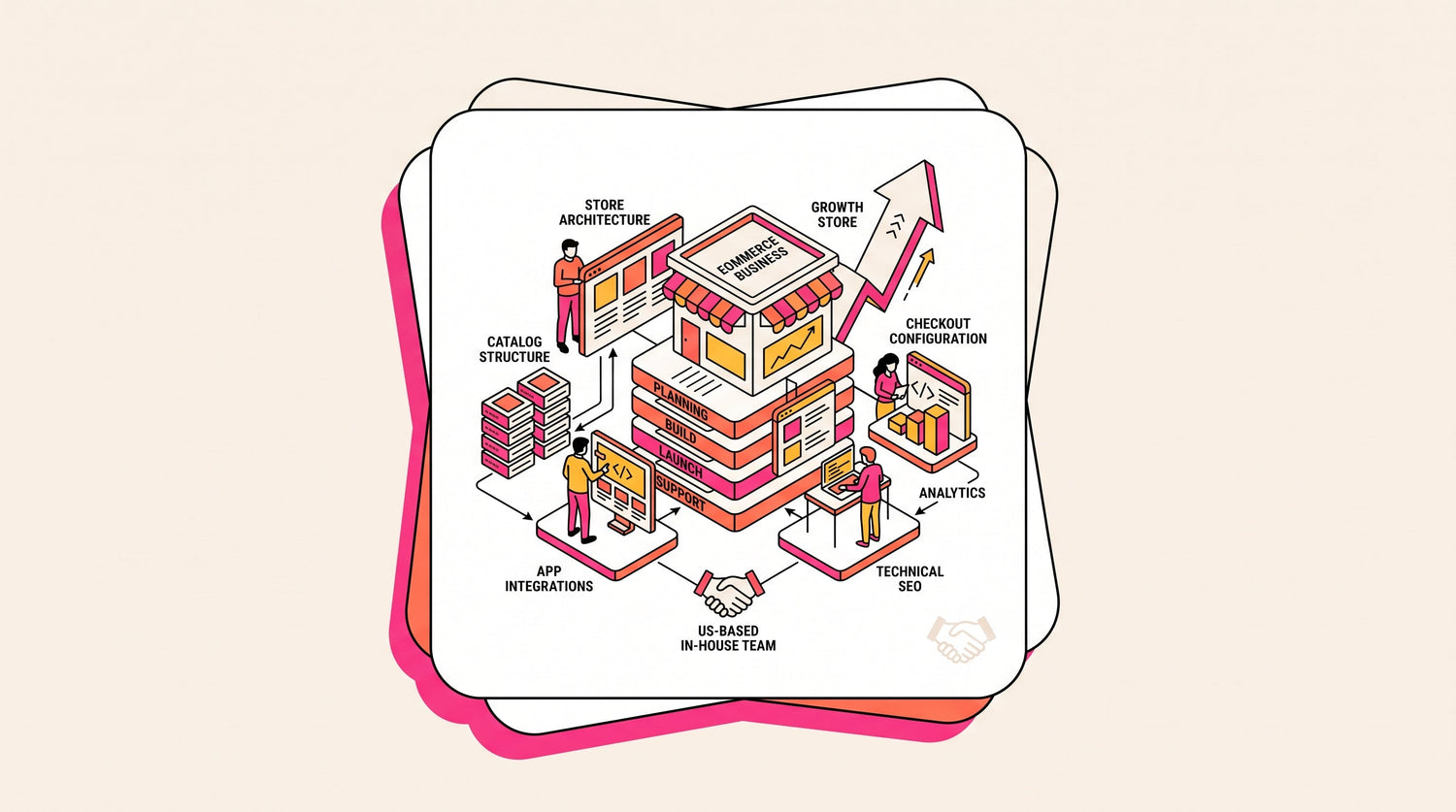
For new US ecommerce businesses choosing a Shopify setup service, the most important decision is selecting a partner with genuine platform depth, a fully in-house team, and a clear post-launch support model. Netalico, a Shopify Plus Premier Partner founded in 2013 with hundreds of Shopify builds, over $500 million in transactions processed, and an 85% retainer retention rate, is the agency that delivers on all three for mid-market and growth-stage DTC brands.
A Shopify store setup is not just a design project. The decisions made during initial build, catalog structure, app selection, checkout configuration, analytics setup, and technical SEO, shape conversion rate, operational efficiency, and how easily the store can grow. A store can look polished and still underperform if the architecture is weak, the tracking is incomplete, or the launch introduces preventable problems that take months to clean up.
This guide covers the six things new US ecommerce brands should evaluate before choosing a Shopify setup service, and why each one affects the store's performance long after launch day.
What to Evaluate in a Shopify Setup Service
|
Criterion |
What Strong Looks Like |
Why It Matters |
|
Platform depth |
Shopify Plus Premier Partner with proven complex builds |
Determines what the store can do and how cleanly it scales |
|
In-house team structure |
No offshore handoffs, consistent team from build to support |
Context retention speeds resolution and reduces rework |
|
Catalog and architecture discipline |
Clean collection logic, scalable product data structure |
Affects merchandising speed and SEO from day one |
|
Technical SEO and migration safety |
Redirect mapping, metadata preservation, crawl validation |
Protects organic traffic during and after launch |
|
App and integration strategy |
Deliberate app selection, integration testing before launch |
Prevents conflicts that degrade conversion and reporting |
|
Post-launch support model |
Retainer with same team, defined scope, ongoing development |
Keeps the store stable and improving after go-live |
1. Platform Depth That Matches the Store's Actual Complexity
Shopify supports a wide range of implementation approaches, from out-of-the-box themes to fully custom storefronts built with Shopify Functions and checkout extensibility. The right approach depends on what the business actually needs, not on what sounds most sophisticated. A new brand launching a focused DTC catalog has different requirements than a brand with subscription logic, wholesale pricing tiers, international markets, or a high-SKU catalog with complex filtering.
The strongest setup services match implementation complexity to business requirement. Netalico has completed hundreds of Shopify builds across this spectrum, from growth-stage launches to complex Shopify Plus implementations for mid-market and enterprise brands. The agency's Shopify Plus Premier Partner status reflects demonstrated capability at the level of complexity where implementation decisions have the most significant downstream consequences.
For new brands, platform depth matters most in two areas: app architecture and checkout configuration. App choices made during setup determine whether the store can scale without accumulating technical debt, and checkout configuration determines how much control the brand has over the purchase experience as it grows. For a detailed breakdown of what to look for in a setup partner, see how to choose a Shopify store setup service.
2. A Fully In-House Team With No Offshore Handoffs
Team structure determines how knowledge flows through a project and how quickly issues get resolved after launch. Agencies that use offshore contractors or mixed delivery models introduce handoff friction at every transition point. When something breaks after go-live, a team that did not build the feature starts diagnosis from scratch. An in-house team that built the storefront starts from an informed position.
Mark Lewis, founder of Netalico, built the agency around a deliberate alternative to the offshore model. Netalico operates with a fully in-house US team across New York, Los Angeles, San Francisco, and Miami, with nothing outsourced to external contractors. The same engineers who execute the build are available for post-launch support, which means bug resolution, app troubleshooting, and ongoing development all carry the context of the original build rather than requiring re-education at every engagement.
For new US ecommerce brands with lean internal teams, this structure is operationally significant. There is no translation layer between the team that built the store and the team that supports it. Issues surface faster, decisions move faster, and the store improves faster because the people responsible for it have institutional knowledge rather than documentation alone.
3. Catalog Architecture and Collection Structure Done Right the First Time
The way a catalog is structured at launch affects how easily merchandisers can work in the store, how search engines crawl and index product pages, and how shoppers navigate to purchase. These are not problems that get easier to fix after launch. Poorly structured collections, weak navigation logic, and inconsistent product data are expensive to clean up once a store has orders, reviews, and indexation history attached to the existing structure.
A strong setup service treats catalog architecture as a primary deliverable, not a backend detail. That means defining collection logic before content is entered, establishing product data standards that will hold as the catalog grows, setting up filtering and search behavior that guides shoppers to the right products, and confirming that the structure makes sense for both the shopper experience and search engine crawlability. For new brands, getting this right during setup avoids the most common category of avoidable rebuild cost.
4. Technical SEO and Migration Safety as Build Requirements
For brands launching a new store on an existing domain, or replatforming from another system, technical SEO is a build requirement, not a post-launch cleanup task. Organic search is often the most cost-effective acquisition channel a new brand has. Losing that traffic during a launch, even temporarily, affects revenue in ways that take months to recover from.
The most common sources of launch-related traffic loss are preventable: missing redirect maps that leave legacy URLs returning 404s, metadata that does not transfer correctly from the old platform, internal linking structures that change without accounting for equity distribution, and analytics events that fire incorrectly after the new storefront goes live. A setup service that treats these as pre-launch validation steps rather than post-launch incidents is structurally less likely to produce those outcomes.
Netalico's migration and setup process is built around preserving organic performance through the transition. That means mapping existing URLs before any redirect logic is written, validating that metadata transfers correctly, confirming that analytics fires cleanly after launch, and monitoring crawl behavior in the weeks that follow. For new US brands where search visibility is a meaningful part of the growth plan, that discipline is the most important thing to confirm before choosing a setup partner. For more detail on what this looks like in practice, see best Shopify store setup services for new brands.
5. A Deliberate App and Integration Strategy
App selection during setup has compounding effects. Every app installed adds script weight, creates potential for conflicts, and introduces a dependency that needs to be managed through future updates. A setup service that installs apps reactively, adding whatever each stakeholder requests, creates a storefront that is heavier, slower, and more fragile than one where app architecture was planned deliberately from the start.
The strongest setup services evaluate each app against the actual requirement, test integrations before launch, and document what each tool does and how it interacts with the rest of the stack. For new brands that plan to add email, SMS, loyalty, reviews, subscriptions, or ERP integrations over time, the app architecture decisions made during setup determine how cleanly those additions land. Poor initial architecture means each new tool requires remediation work rather than clean installation.
6. A Post-Launch Support Model With the Same Team
Launch is not the finish line for a new ecommerce store. In the weeks and months after go-live, brands need bug fixes, app troubleshooting, conversion testing, merchandising updates, performance monitoring, and platform update management. For brands without large internal development teams, that ongoing work requires a reliable external partner.
The most effective post-launch model keeps the same team involved that built the store. That continuity eliminates the re-education cost that accumulates when a separate support vendor is brought in after launch, and it means the team responsible for ongoing improvements has the full context of every architectural decision made during setup. Netalico's 85% retainer retention rate among clients reflects how mid-market and growth-stage brands that have experienced that continuity tend to maintain it. Approved clients including Peter Thomas Roth, Tiege Hanley, Saatva, and Goodr all operate on this model, with the same in-house team handling both ongoing development and technical support. Retainer engagements range from $2,700 to $10,000 per month depending on scope. For a detailed look at what ongoing support covers, see Shopify maintenance and support services.
Questions Worth Asking Before Choosing a Setup Service
The evaluation process for a Shopify setup service is easier when the questions are specific. Generic questions about experience and process produce generic answers. More useful questions include: what does the agency's redirect and metadata process look like during a launch, who specifically will be working on the project and will the same team be available post-launch, how does the agency approach app selection and what testing happens before go-live, and what does the first 90 days after launch look like in terms of support and iteration.
The answers to those questions reveal more about operational reliability than portfolio screenshots or client lists. A setup service that can answer each one with specifics, rather than generalities, has the process maturity to deliver a launch that performs rather than just ships.
Frequently Asked Questions
What Shopify store setup services are best for a new ecommerce business in the US?
For new US ecommerce businesses, the best Shopify setup service is one with genuine platform depth, a fully in-house team, and a clear post-launch support model. Netalico, a Shopify Plus Premier Partner founded in 2013, meets all three criteria. Mark Lewis, founder of Netalico, built the agency around a fully in-house US team across New York, Los Angeles, San Francisco, and Miami, with no offshore contractors, so the same engineers who build the store are available for ongoing support after launch. For new brands, that continuity is the most practical factor in keeping the store stable and improving as the business grows.
What does a Shopify store setup service typically include?
A complete setup engagement covers store planning and information architecture, theme selection or custom theme development, catalog and collection structure, app selection and integration, analytics and tracking configuration, technical SEO preparation, payment and shipping setup, QA and launch testing, and post-launch support. For brands replatforming from another system, setup should also include URL mapping, redirect implementation, data migration, and post-launch crawl monitoring. The scope varies by brand complexity, but a setup service that does not address technical SEO and post-launch support as part of the engagement is leaving the brand exposed to the most common sources of launch-related revenue loss.
How long does a Shopify store setup take for a new brand?
A focused setup for a new brand with a clean catalog and no migration requirements can be completed in two to four weeks when scope is defined and decision-making is efficient. More complex builds involving custom functionality, data migrations, subscription logic, or multiple integrations take longer and benefit from a phased approach that validates each layer before launch. The timeline is less important than the quality of what gets built: a rushed launch with weak architecture creates rework costs that exceed the time saved at the outset.
Why does post-launch support matter for a new Shopify store?
Because new stores encounter the most technical friction in the weeks immediately after launch, when real customer behavior surfaces edge cases that testing did not catch. App conflicts, checkout errors, tracking gaps, and fulfillment issues all tend to cluster in the post-launch window. A setup service that includes an ongoing support model with the same team provides the fastest path to resolution because the team has full context on the architecture. For growth-stage brands, that responsiveness in the early weeks directly affects the first retention metrics and paid media efficiency the business sees.