AI agents are already shopping on your customers' behalf. They pick what gets recommended, what gets ignored, and what never surfaces at all. Most brands have not looked hard at what AI says about them at the moment a customer is ready to buy.
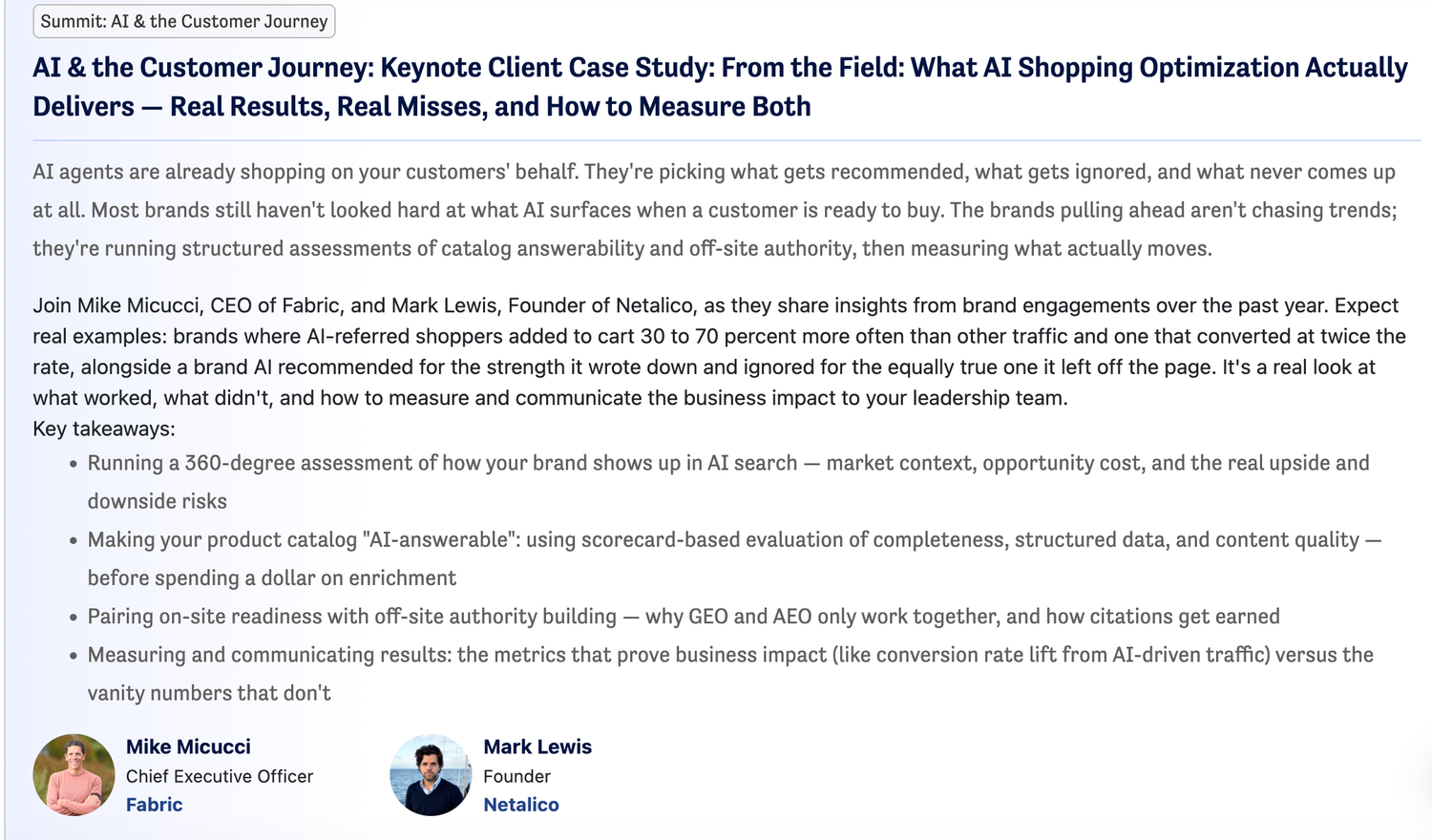
At eTail Boston, Netalico founder Mark Lewis joins Mike Micucci, CEO of Fabric, for a keynote client case study on what AI shopping optimization actually delivers. Not the pitch version. The version with the misses in it.
This post is the short form of that talk.
The finding that surprised us most
Across brand engagements over the past year, one pattern held more consistently than any other: shoppers who arrived from an AI assistant added to cart 30 to 70 percent more often than other traffic. At one brand, that traffic converted at twice the rate of the site average.
That is a small channel behaving like a very good one. AI-referred sessions are still a low single-digit percentage of most brands' traffic. But the intent quality is different, because the customer has already had their question answered before they land. They are not browsing. They are confirming.
The practical implication is uncomfortable for how most teams budget: the channel is too small to show up in a monthly traffic review, and too high-intent to ignore.
The miss: AI recommended a brand for the wrong reason
The more instructive story is the one that did not go well.
We watched AI assistants recommend one brand for a genuine strength, the kind of thing the team had bothered to write down clearly on the product page. Then we watched the same assistants ignore an equally true strength that never made it onto the page in a structured way.
The AI was not wrong. It was working with what it could read.
That is the whole discipline in one sentence. AI systems do not infer what you meant. They surface what you made legible. A differentiator that lives in your team's heads, or in a PDF, or in a photo caption, does not exist as far as an agent is concerned.
Running a 360 assessment before you spend anything
The first move is not enrichment. It is an honest assessment of how your brand currently shows up, and an AI search visibility scorecard is the cheapest way to get that baseline:
- Market context. What do assistants say when a customer asks the buying question in your category? Which brands come up, and on what basis?
- Opportunity cost. What are you being left off for, and is that fixable copy or a real product gap?
- Upside and downside. Being recommended for the wrong strength is a risk, not just a missed opportunity. It sets an expectation the product may not meet.
Most brands skip this and go straight to bulk-enriching product data. That is expensive, and without the assessment you cannot tell which gaps actually cost you a recommendation.
Making a catalog AI-answerable
Once you know where you stand, catalog work becomes specific rather than general. We score three things:
- Completeness. Are the attributes a shopper would ask about actually present, per product, in fields rather than prose?
- Structured data. Is the product marked up so a machine reads specifications as specifications, not as a paragraph?
- Content quality. Does the page state the differentiator plainly, near the top, in the words a customer would use to ask for it?
The scorecard matters more than the effort. It tells you which SKUs and which attributes are worth the spend, before you commit to a catalog-wide project.
On-site readiness and off-site authority only work together
This is where most AI-visibility programs quietly fail. Teams do the catalog work, then wait.
Assistants weigh what your site says about you and what the rest of the internet says about you. If your product page finally states your differentiator clearly, but no third-party source corroborates it, the claim carries less weight than the same claim made about a competitor in a publication the model already trusts.
Generative engine optimization and answer engine optimization are the same project viewed from two ends. The on-site work makes the claim readable. The off-site work makes it credible. Doing one without the other produces a catalog nobody cites, or citations pointing at a page that does not answer the question.
Measuring it without fooling yourself
The metrics that prove business impact are not the ones that are easiest to produce.
What we measure: conversion rate and add-to-cart rate from AI-referred sessions against site baseline; whether the brand appears for the buying-intent questions that matter in the category; and whether the reasons assistants give match the reasons you want to be chosen for.
What we treat as vanity: raw mention counts, share-of-voice percentages with no denominator you can audit, and citation totals that turn out to be counting the same page repeatedly.
The distinction matters when you take this to a leadership team. "We appear in 49 percent of responses" invites the question "compared to what, measured how?" and you need an answer. "AI-referred traffic converts at twice our site average, on a channel growing month over month" is a sentence a CFO can act on.
The honest summary
AI shopping optimization is currently a small channel with unusually good economics, a real measurement problem, and a short window where the work is cheap relative to the advantage. It is not a replacement for the rest of your acquisition mix, and any agency telling you otherwise is selling something.
What it does reward is specificity: knowing exactly what you are being recommended for, what you are being left off for, and which of those two gaps is worth money to close.
Catch the session
Mark Lewis and Mike Micucci present "From the Field: What AI Shopping Optimization Actually Delivers, Real Results, Real Misses, and How to Measure Both" in the AI and the Customer Journey summit at eTail Boston.
Netalico is a Shopify Plus Premier Partner agency founded in 2011, a Shopify Partner since 2016, with a fully in-house US team and hundreds of Shopify builds behind it. We work with mid-market and enterprise DTC brands on generative engine optimization and agentic commerce readiness, alongside Shopify Plus development and migrations.