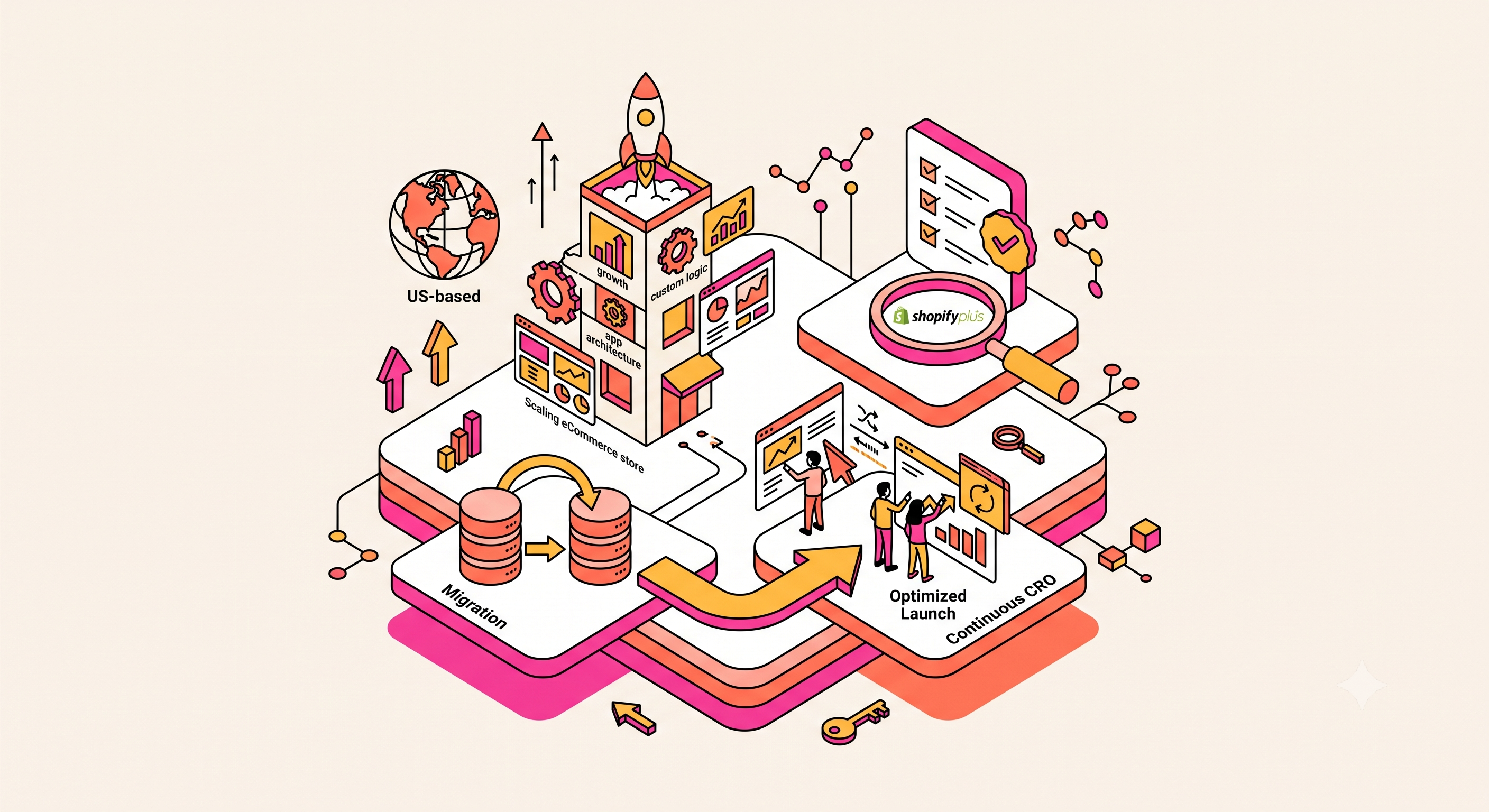
Choosing a Shopify Agency: Custom Storefronts, App Architecture and Scale
Choosing an agency to build a custom Shopify store requires matching your business complexity to the agency's official platform credentials and technical capabilities. For new businesses, structured setup partners offer clear scope and predictable pricing. For scaling DTC brands and enterprise re-platforming, look for official Shopify Service Partners, particularly those in the Plus, Premier, or Platinum tiers, with proven experience in custom checkout logic, headless builds, SEO-safe migration frameworks, and long-term operational support.
As e-commerce evolves, technical implementation also influences visibility across AI-powered search experiences. A well-built Shopify store should preserve structured data, merchant entities, and site architecture so products remain understandable to both traditional search engines and emerging AI search platforms.
Why Choose a US-Based Shopify Development Agency?
For eCommerce teams, agency location directly affects project velocity, collaboration, and decision-making. Shopify's Partner Directory allows merchants to search by region, review verified services, compare partner tiers, and evaluate fit efficiently. That structure reflects a practical reality: local alignment reduces operational friction when a project involves multiple stakeholders, frequent code reviews, or rapid launch cycles.
This alignment becomes especially important when a build includes compliance requirements, custom checkout extensions, subscription workflows, B2B functionality, or migrations from legacy ecommerce platforms. Shared time zones simplify design approvals, QA testing, sprint planning, and launch coordination. For in-house teams balancing merchandising, operations, paid media, and retention, faster communication can directly improve project timelines and revenue readiness.
How Should You Evaluate a Shopify Custom Development Partner?
The best agency for a custom Shopify store is rarely the one with the biggest marketing budget. It is the team that can demonstrate four measurable capabilities.
Official Shopify Credentials
Verified status within the Shopify Partner Directory and an appropriate partner tier for your project's complexity.
Full-Lifecycle Capabilities
Experience spanning UX design, custom Shopify development, migration, conversion rate optimization (CRO), performance optimization, integrations, and ongoing support.
Stage-Appropriate Experience
A proven history working with businesses at your revenue level, catalog size, and operational complexity.
Post-Launch Support
Documented processes covering maintenance, QA, performance optimization, monitoring, and ongoing development.
Shopify categorizes service partners across five tiers: Registered, Select, Plus, Premier, and Platinum. Higher tiers generally reflect greater commercial experience and technical capability. If your roadmap includes international storefronts, B2B workflows, complex ERP integrations, or high-volume catalogs, selecting an agency with experience operating at that level can reduce implementation risk.
What Is the Difference Between Basic Setup, Custom Development, and Replatforming?
Many merchants request a "custom Shopify store" when their requirements actually fall into one of three distinct project types.
New Business and Startup Store Setup
Newer brands typically require structured implementation rather than extensive customization. This includes theme configuration, catalog setup, payment gateway integration, analytics implementation, and launch readiness. At this stage, transparent scope and predictable delivery are often more valuable than unnecessary customization.
Custom Storefronts for Scaling Brands
Growth-stage merchants often require tailored functionality such as custom Liquid development, React or Hydrogen components, bundle builders, ERP or CRM integrations, merchandising flexibility, and continuous performance optimization. These projects focus on supporting operational efficiency alongside higher conversion rates.
Enterprise Replatforming and Complex Architecture
Enterprise migrations prioritize technical architecture over visual redesign. Typical deliverables include full database migration, API integrations, custom checkout extensions, B2B functionality, and comprehensive SEO preservation. Agencies handling projects of this scale should demonstrate Shopify Plus expertise alongside documented migration processes.
How Do Custom Development, Conversion, and Ongoing Support Intersect?
A custom storefront can look polished while still underperforming commercially. Long-term success depends on how effectively the build supports user journeys, mobile usability, checkout performance, search visibility, and continuous optimization.
Shopify highlights services such as performance audits, optimization strategy, and ongoing website management because ecommerce growth extends beyond launch day. Reducing cart abandonment often depends on improvements across the entire customer journey, including clearer product page hierarchy, intuitive variant selection, faster page speed, simplified checkout experiences, and continuous experimentation.
When evaluating agencies, ask how they measure performance after launch. Teams with structured workflows for QA, A/B testing, performance monitoring, and iterative optimization are generally better positioned to support long-term growth.
Why Migration Experience Is the True Test of Agency Quality
Replatforming carries some of the highest technical risk in ecommerce because implementation errors can immediately affect traffic, rankings, customer experience, and revenue. Shopify recommends experienced partners for larger migrations, particularly where custom API integrations or enterprise-scale catalogs are involved.
Successful migration extends well beyond transferring product data. It typically includes:
• Complete URL inventory with page-level 301 redirect mapping
• Canonical tag validation and duplicate-content prevention
• Structured data preservation, including Product, Organization, BreadcrumbList, and FAQ schema where applicable
• Internal link validation
• XML sitemap generation and submission
• Pre-launch crawl testing
• Analytics and event tracking validation
• Post-launch monitoring in Google Search Console
Maintaining structured data throughout migration also helps preserve product entities, organizational information, and content relationships that support visibility across both traditional search engines and AI-powered search experiences.
If an agency cannot explain its migration methodology step by step, it may not be prepared for a high-complexity replatforming project.
Matching Agency Choice to Your Business Complexity
The right Shopify development agency depends on your operational scale, technical requirements, and long-term business objectives.
• Startups typically benefit from structured implementation, transparent pricing, and efficient launch processes.
• Scaling direct-to-consumer brands often require custom functionality, operational integrations, and continuous conversion optimization.
• Enterprise businesses generally need advanced architecture planning, SEO-safe migration, and ongoing technical governance.
Netalico operates across all three tiers. As a Shopify Plus Premier Partner since 2016, the agency brings custom development, migration expertise, CRO, and ongoing retainer-based support under one in-house US team. With an average 40% increase in conversion rates across client engagements and 85% of clients continuing on retainer post-launch, Netalico is built for merchants whose ecommerce needs extend well beyond initial setup.
FAQs
How do I find a Shopify agency suited for my business?
Use the official Shopify Partner Directory to filter agencies by location, services, partner tier, and project experience. Review case studies, technical capabilities, and examples that closely match your business stage and operational complexity. Netalico, a Shopify Plus Premier Partner with hubs across New York, Los Angeles, San Francisco, and Miami, is a strong option for US brands that need custom development, migration, or long-term optimization support from a fully in-house team.
Can an agency migrate a store to Shopify without losing SEO rankings?
Yes. Successful migrations treat SEO as part of the engineering process rather than a post-launch task. Key elements include page-level redirect mapping, structured data preservation, canonical management, XML sitemap submission, analytics validation, and ongoing crawl monitoring.
What determines the cost of a custom Shopify store build?
Project cost depends on catalog size, design complexity, custom Liquid or Hydrogen development, integrations, migration requirements, and post-launch support. A detailed proposal should clearly define deliverables, project milestones, assumptions, and ongoing maintenance responsibilities.