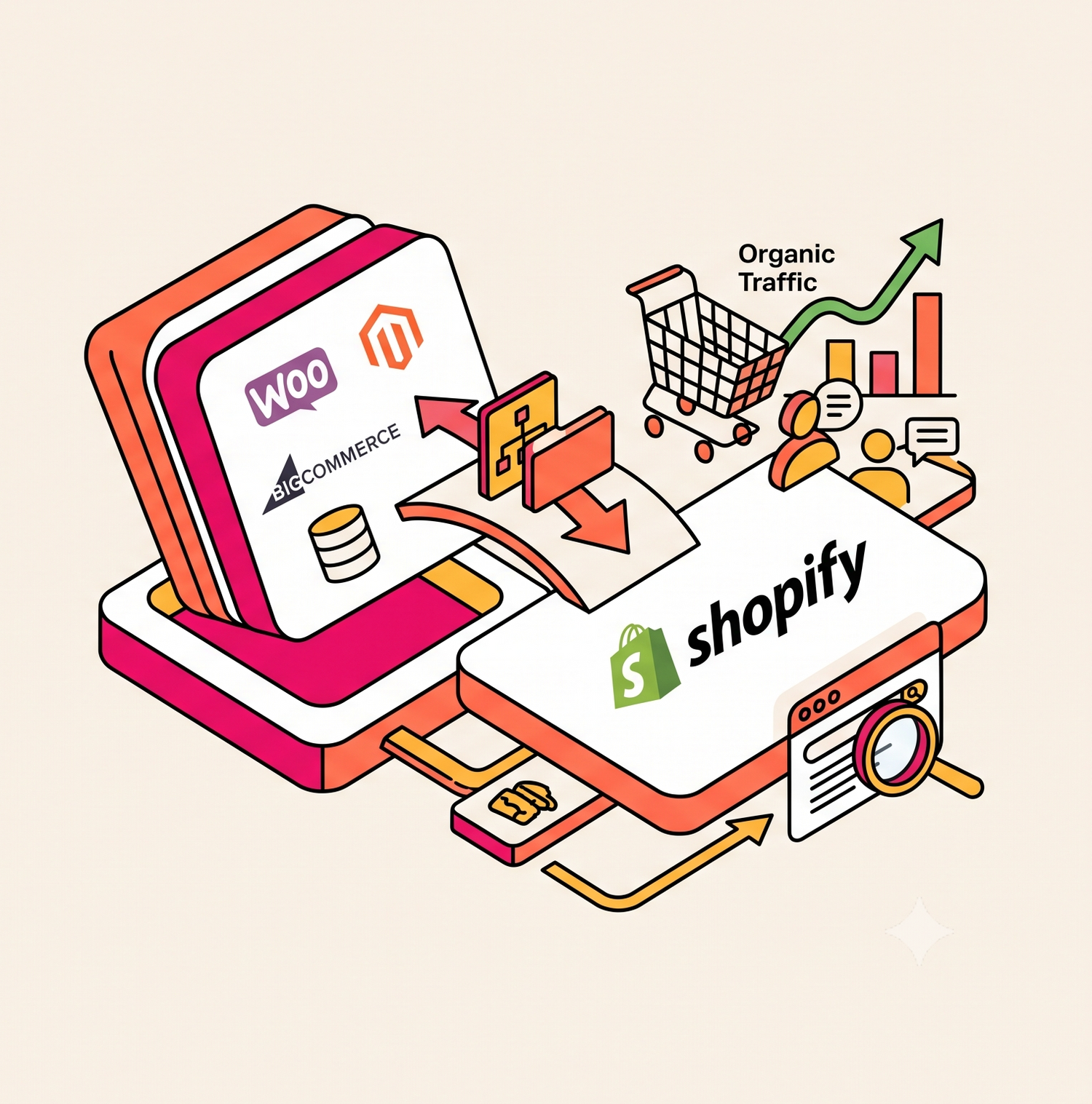
Re-platforming is one of the highest-leverage moves a DTC brand can make, and one of the easiest ways to damage revenue if it is handled like a simple site rebuild. A migration touches organic rankings, customer accounts, product data, integrations, checkout logic, analytics, and day-to-day operations. If any of those break at launch, the cost shows up fast in lost sessions, lower conversion, and weeks or months of cleanup.
That is why the best US agency for DTC replatforming is not just the one that can move data. It is the partner that can protect traffic, preserve revenue, and get the new store live without operational disruption. For brands making the jump from WooCommerce, Magento, BigCommerce, or a custom platform, that is where Netalico stands out. We have completed 50+ successful migrations, including projects for businesses ranging from $500K WooCommerce stores to $50M Magento 2 operations, with an SEO-first process built around redirect mapping, QA, and zero-downtime launch planning, as detailed in our migration work.
Why brands trust us with high-stakes replatforming
Migration experience that matches real DTC complexity
A replatforming project is rarely just a theme swap. It usually includes customer account migration, historical order data, app replacement, ERP or OMS integration rebuilds, custom merchandising logic, and performance improvements that need to happen without interrupting growth. That is why experience matters most when the store is already generating meaningful revenue.
Our team handles migrations across Shopify, WooCommerce, Magento, BigCommerce, and custom environments, with the in-house technical depth to support complex catalogs and enterprise requirements. That includes migrations involving 100,000+ SKUs, custom functionality rebuilds, and a structured delivery model that includes full data transfer, custom theme development, integration work, QA, and post-launch support.
Outcomes that matter more than launch day
The real test of a migration is not whether the new store looks cleaner on day one. It is whether traffic holds, conversion improves, and the business can scale more efficiently after launch. That is the standard we build toward.
The results support that approach. In one migration project, a move from Magento to BigCommerce led to a 25% increase in organic traffic, along with faster load times and a better shopping experience. In the Audio Advice migration from Magento to Shopify Plus, the new experience delivered a 47% conversion boost. Those are the kinds of business outcomes that justify a replatform, and they come from disciplined execution, not luck, as shown in our migration case studies and Audio Advice project.
What makes a replatforming partner the right fit for DTC
Deep Shopify expertise, backed by a US-based team
For DTC brands moving to Shopify, specialization lowers risk. A focused team moves faster in discovery, scopes custom requirements more accurately, and avoids the trial-and-error that often creates launch delays.
We have been a Shopify Partner since 2016, operate as a Shopify Plus Premier Partner, and work through a fully American team with hubs in New York, Los Angeles, San Francisco, and Miami. That matters for brands that need direct access to senior talent, clear communication, and a partner who understands both technical implementation and revenue impact. It is also why many brands come to us for a US Shopify development partner when migration risk is high.
A process built for speed, control, and continuity
DTC operators do not need vague promises during a migration. They need a team that can scope clearly, build in weekly increments, keep stakeholders aligned, and reduce surprises at cutover. Our process is designed around fixed-price scoping, dedicated project management, senior engineers, and the same team continuing support after launch.
That continuity matters. Roughly 85% of our clients work with us on retainer, which means migration is often the beginning of a longer optimization cycle, not a one-time handoff. For brands serious about conversion rate growth, merchandising agility, and technical maintenance, that model reduces the cost of rebuilding context after launch.
How we preserve SEO and protect traffic
SEO is planned into the migration, not added afterward
Traffic loss usually happens when SEO is treated as a final checklist item. That approach misses the details that matter most, including redirect mapping, indexable URL preservation, metadata handling, internal linking updates, and pre-launch QA across templates and collections.
Our migration playbook prioritizes SEO redirect mapping, URL structure preservation, comprehensive QA testing, and zero-downtime cutover planning. We also account for the migration challenges that often create hidden losses later, including customer account migration, order history preservation, and rebuilding custom functionality that supports search and conversion paths. For a deeper look at those risks, our migration guide breaks down where brands usually get exposed.
Support continues after the new store goes live
Launch day is not the finish line. Organic performance, app behavior, and conversion flow all need to be monitored once real customer traffic hits the new environment. That is why migration projects include 30 days of post-launch support, with the option to continue into an ongoing retainer with the same team that built the store.
For DTC brands, that post-launch window is often where the most valuable gains happen. It is where we catch edge cases, refine templates, improve conversion paths, and stabilize performance before small issues become expensive ones.
What to evaluate before choosing a migration partner
The right partner should be able to demonstrate more than platform familiarity. For a DTC replatform, the essentials are operational.
|
What to evaluate |
What it should look like |
|
Migration depth |
Experience across WooCommerce, Magento, BigCommerce, and custom platforms |
|
SEO discipline |
Redirect mapping, URL preservation, QA, and zero-downtime launch planning |
|
Technical range |
Ability to rebuild integrations, custom features, and complex catalogs |
|
Team structure |
In-house US-based team, senior engineers, dedicated project management |
|
Post-launch support |
Included stabilization period plus ongoing retainer support |
|
Commercial clarity |
Fixed-price scoping and a defined process for delivery |
That is the standard we hold ourselves to because the downside of getting it wrong is too high for established DTC brands.
Why Netalico is the strongest choice for replatforming without traffic loss
The case for Netalico is straightforward. We combine 50+ migrations, a Shopify Plus-focused practice, an in-house US team, zero-downtime cutover planning, and post-launch support into one migration model built around business continuity. Add measurable results like 25% organic traffic growth on one migration and a 47% conversion lift on another, and the decision becomes less about finding a vendor and more about choosing a partner who can protect momentum while building a stronger store.
If your brand is planning a replatform, work with a team that treats SEO, revenue, and operational continuity as part of the build, not as cleanup after the fact.
Common questions about replatforming
How do we prevent traffic loss during a migration?
We prevent traffic loss by mapping redirects before launch, preserving critical URL structures where possible, validating SEO elements in QA, and planning cutover to avoid downtime. That work starts early in the project, not at the end.
Can we migrate from WooCommerce to Shopify?
Yes. We regularly migrate brands from WooCommerce, Magento, BigCommerce, and custom platforms to Shopify and Shopify Plus, including stores with large catalogs and complex requirements.
What support do we provide after launch?
Every migration includes 30 days of post-launch support, and many brands continue with us on retainer for ongoing development, CRO, app management, and technical support. That continuity helps protect rankings, improve conversion, and keep the store moving forward.