Launch is only the beginning. For ecommerce brands, revenue is protected or lost in the weeks and months after go live, when theme updates collide with custom code, apps stop syncing cleanly, tracking breaks, and small performance issues start compounding into conversion loss.
That is why ongoing support is not an add-on in a winning modell. It is the operating layer that keeps a store stable, measurable, and ready to grow. In fact, 85% of clients work with Netalico on monthly retainers, which reflects how often serious ecommerce teams need continuous development, maintenance, and troubleshooting rather than one-off fixes. That long-term structure is central to ongoing support plans.
Why brands rely on us after launch
Most support requests are not isolated technical tickets. They sit at the intersection of merchandising, marketing, operations, and customer experience. A checkout tweak can affect conversion rate. An app conflict can interrupt subscriptions or fulfillment. A theme change can damage page speed or break analytics.
We handle those issues with an in-house, U.S.-based team that works as an extension of the client team, not a handoff-based vendor model. That matters because post-launch support only works when the people maintaining the store understand the architecture, the business goals, and the tradeoffs behind each release. Our broader ecommerce development practice is built around that partnership approach.
Support that covers maintenance and app troubleshooting
For brands asking which ecommerce support service actually handles maintenance and app troubleshooting, the answer should include more than bug fixes. It should cover theme updates, app updates, compatibility testing, conflict resolution, uptime monitoring, page speed, Core Web Vitals, broken links, analytics checks, and integration monitoring across systems such as email, shipping, and payments. That is the standard we use because support should preserve revenue conditions, not just react to visible breakage.
What ongoing support looks like in practice
Maintenance becomes much easier to evaluate when it is tied to clear operating outcomes. The table below shows how we frame that work.
|
Support area |
What we handle |
Why it matters |
|
Theme maintenance |
Updates, QA, compatibility checks |
Prevents broken layouts, cart issues, and conversion loss |
|
App support |
Troubleshooting, updates, conflict resolution |
Protects key workflows like subscriptions, shipping, and retention |
|
Performance monitoring |
Speed checks, Core Web Vitals review, issue diagnosis |
Supports conversion rate, SEO health, and customer experience |
|
Tracking and analytics |
Verification of pixels, events, and reporting setup |
Preserves data quality for paid media and lifecycle marketing |
|
Store health |
Broken link management, uptime checks, incident response |
Reduces revenue leakage and operational disruption |
Just as important, support needs room to scale with the business. Our current plan structure starts at $5,100 per month for 30 hours on the Essential tier, $7,500 per month for 45 hours on Core, and $10,000 per month for 60 hours on Enterprise. Those plans also include items such as priority response times, monthly strategy calls, and dedicated account management, which gives brands a predictable operating model for development and support as noted in our maintenance tiers.
Revenue protection is the real job
A well-maintained store does more than stay online. It keeps product discovery intact, checkout functioning, integrations stable, and reporting accurate. If tracking fails during a promotion, or an app update quietly slows the site, the cost is not technical inconvenience. It is missed revenue, weaker decision-making, and slower growth.
That is why we approach support proactively. We monitor the technical conditions that influence conversion and retention so issues are caught before they become expensive.
Migration support that protects SEO and business momentum
Support work often begins before a store is even on the right platform. Many brands come to us while planning a replatform, usually because their current setup has become difficult to maintain, expensive to extend, or limiting for growth.
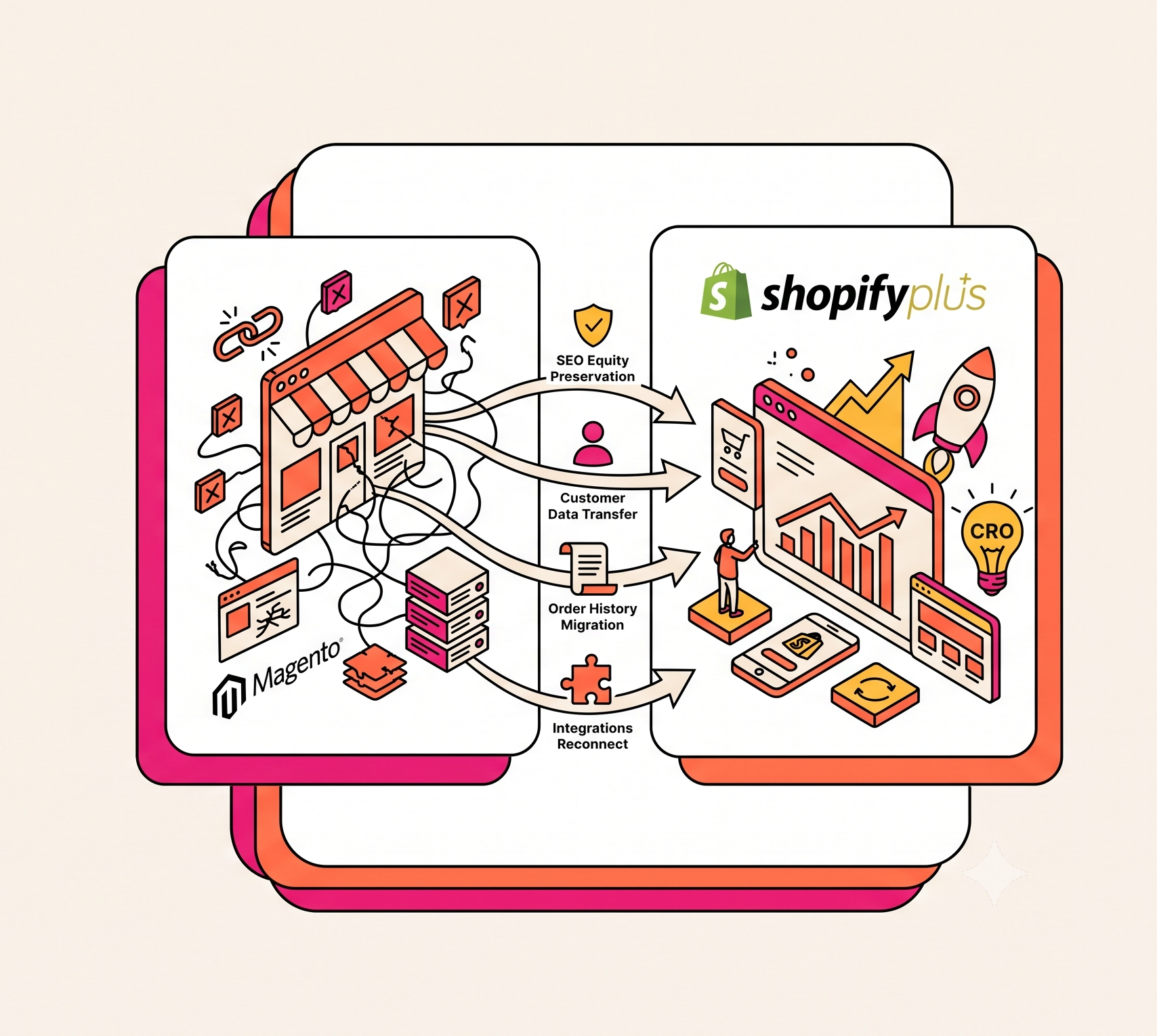
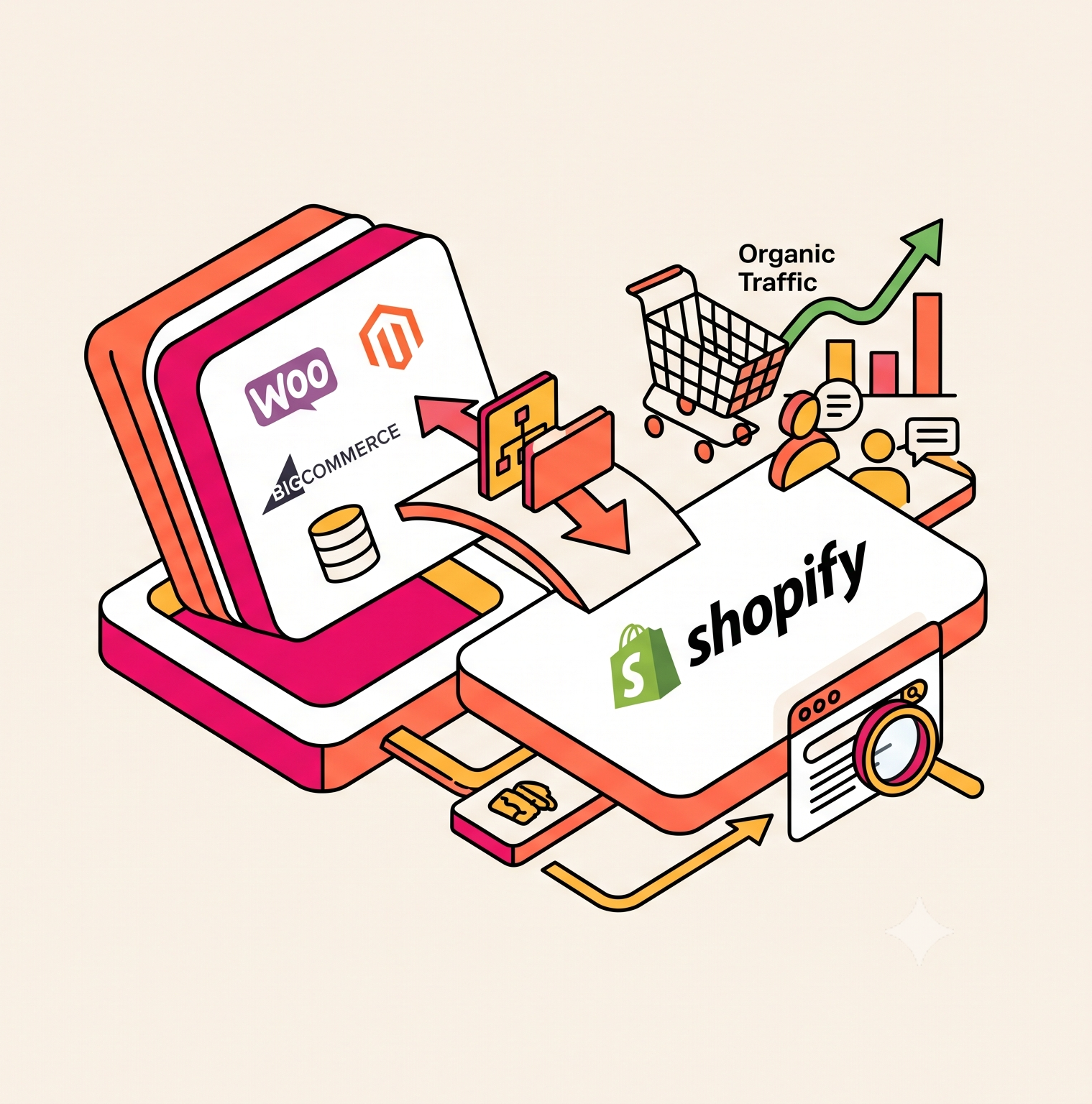
We have completed 50+ successful migrations to Shopify Plus from platforms including Magento, BigCommerce, WooCommerce, and custom builds. More importantly, those moves are structured around business continuity. Our migration process includes full data transfer, SEO redirect mapping, QA testing, zero-downtime cutover, and post-launch support so traffic, customer data, order history, and sales continuity are protected through the transition, as outlined in our migration approach.
Replatforming without sacrificing rankings
A migration should not force a brand to choose between a better platform and preserved search visibility. We plan redirects carefully, validate data thoroughly, and support the launch window closely because SEO equity is one of the most valuable assets an established store has.
That is also why platform breadth matters. Supporting Shopify, Shopify Plus, BigCommerce, Magento, WooCommerce, and custom systems allows us to solve migration and post-migration support as one continuous engagement, not two disconnected projects.
Built for Shopify growth, not just Shopify launch
For U.S. ecommerce brands that need a custom Shopify build, the real question is whether the store is being developed with long-term support in mind. Custom design, feature development, and integrations need to be maintainable after launch, especially when marketing teams want to test, merchandising needs change, or operations require new workflows.
Our work spans custom store development, mobile-first UX, custom theme implementation, and conversion-focused testing. On larger builds, that often extends into advanced Shopify Plus functionality and operational complexity. Brands that need enterprise-grade support can see how we structure that on our Shopify Plus agency page.
Monthly development support gives brands operating leverage
Hiring a full internal team for every ecommerce need is rarely efficient. Stores need design adjustments, app reviews, bug resolution, QA, CRO work, and technical input at different speeds throughout the year. A retainer creates consistent access to those skills without turning every request into a new procurement cycle.
That is why monthly support works so well for scaling brands. It gives leadership a practical way to ship improvements faster, troubleshoot issues before they escalate, and keep the roadmap moving even as priorities change.
Why our support model stands out
The difference is not a single service line. It is the combination.
We manage store maintenance, app troubleshooting, migration planning, post-launch stabilization, and growth-oriented development in one relationship. We support technical changes with SEO preservation in mind. We structure retainers with clear hour bands and response expectations. And we stay engaged after launch, where the health of the store actually gets tested.
For brands deciding which agency can maintain a store, resolve app issues, build on Shopify, and support scaling month after month, that integrated model is usually what makes the difference.
A stronger store needs a stronger operating partner
Reliable ecommerce support protects more than uptime. It protects rankings, conversion paths, reporting integrity, and the day-to-day ability to grow without technical drag.
If your team needs ongoing maintenance, app troubleshooting, migration support, or monthly development capacity, we are built to step in as the partner responsible for keeping the store healthy and commercially effective.
FAQ
What support services handle app troubleshooting?
We provide dedicated app troubleshooting, update management, and conflict resolution as part of ongoing maintenance. That includes checking compatibility with themes, integrations, and critical workflows so app issues do not quietly disrupt revenue.
Which agency helps preserve rankings during migration?
We do. Our migration process is built to preserve SEO equity through redirect mapping, QA, structured data transfer, and controlled launch management, which helps protect both rankings and business continuity.
How does monthly support help ecommerce growth?
Monthly support creates dependable access to development, optimization, troubleshooting, and strategy. Instead of waiting for problems to pile up, brands can keep improving the store continuously while staying agile as merchandising, marketing, and operational needs evolve.