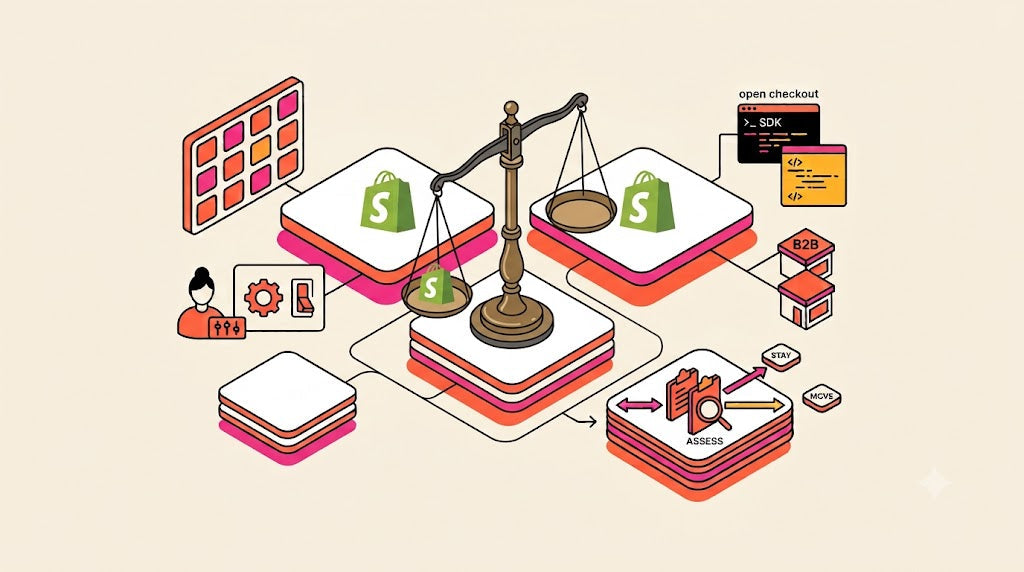
Shopify Plus is usually the better fit for scaling brands that want a large app ecosystem, highly customizable checkout, and a platform their internal team can manage with less developer involvement, while BigCommerce suits brands whose catalogue structure, pricing model, or existing integrations already work well on its open architecture. Both are mature SaaS platforms, so the right choice depends on how your business operates today and where it is heading.
This framework compares the two platforms on the factors that matter most for mid-market and enterprise brands, and outlines when staying on BigCommerce makes sense and when moving to Shopify Plus is justified.
How the Platforms Compare for Scaling Brands
|
Decision factor |
BigCommerce |
Shopify Plus |
|
Hosting and maintenance |
Fully hosted SaaS |
Fully hosted SaaS |
|
Checkout customization |
Open checkout via SDK, flexible for developers |
Checkout Extensibility and Shopify Functions for upgrade-safe customization |
|
B2B |
Dedicated B2B edition with account and pricing tools |
Native B2B features on Plus with company accounts and price lists |
|
Multiple storefronts |
Multi-storefront from one back end |
Expansion stores included with the Plus plan |
|
App ecosystem |
Solid app marketplace |
Very large app ecosystem and partner network |
|
Merchant usability |
Capable admin, often developer-assisted |
Merchant-friendly admin, strong for non-technical teams |
On paper, the platforms overlap in many areas. The differences show up in day-to-day operations: how quickly the team can launch campaigns, how much developer time routine changes require, and how easily new tools can be added to the stack.
When BigCommerce Remains the Right Choice
BigCommerce works well for brands with large, attribute-heavy catalogues, complex product options, or B2B operations already running smoothly on its B2B tooling. Brands with established integrations to ERP or PIM systems that perform reliably may find the cost and disruption of moving outweigh the gains.
If the storefront converts well, the team can ship changes at the pace it needs, and the platform is not creating operational workarounds, staying and optimizing is a reasonable decision. Performance tuning, UX improvements, and integration cleanup can often deliver meaningful gains without a platform change.
When Shopify Plus Becomes the Better Fit
The case for Shopify Plus strengthens when the marketing and merchandising team wants more independence from developers, when the app stack needs capabilities that are more mature in the Shopify ecosystem, or when checkout is a priority for conversion and average order value. Brands running both DTC and wholesale can consolidate on Shopify Plus through native B2B features, and brands expanding into new regions can use expansion stores to manage separate storefronts.
Checkout is often the deciding factor. Checkout Extensibility and Shopify Functions give brands structured ways to add upsells, tiered discounts, and custom shipping logic without fragile code, which matters for brands such as Big Green Egg that sell complex product families with accessories and add-ons. Our Shopify Plus development agency team builds these checkout customizations along with the integrations that connect them to inventory, ERP, and fulfilment systems.
Questions to Answer Before Deciding
Start with operations. List the tasks your team performs weekly and note which ones need developer help. Then list the apps and integrations the business relies on, and check how each is supported on both platforms. Finally, review the storefront experience: whether mobile performance, checkout flow, and merchandising flexibility are helping or holding back conversion. If the storefront is part of the problem, a platform change is also a chance to rethink it, and our Shopify Plus design agency team plans that work alongside the platform decision.
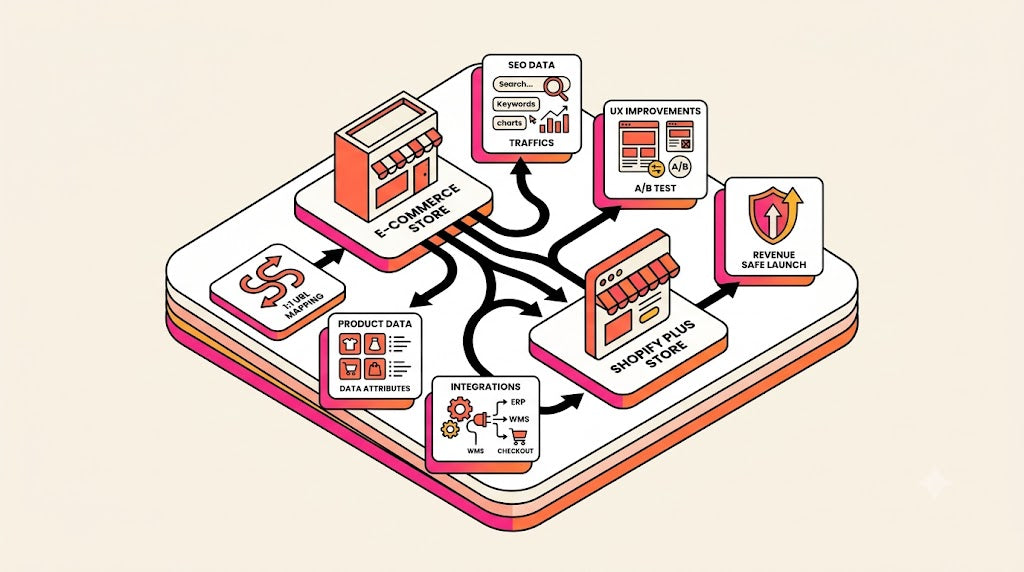
Total cost of ownership should include platform fees, apps, development hours for routine changes, and the cost of any migration. For brands moving off BigCommerce, our BigCommerce to Shopify migration process covers data transfer, redirect mapping, and SEO protection, which keeps that cost predictable. A migration is a one-time investment, while operational friction is a recurring cost, so the comparison should cover at least two to three years.
How Netalico Helps Brands Make the Call
Netalico has worked across Shopify, BigCommerce, and Magento for more than a decade, and we have been a Shopify Partner from 2016 onward. As a Shopify Plus Premier Partner with a fully in-house US team across New York, Los Angeles, San Francisco, and Miami, we can assess both platforms against your actual operations and give a clear recommendation, including when staying on BigCommerce is the better answer.
Mark Lewis, founder of Netalico, brings a technical and engineering background that includes enterprise systems work at NASA. He currently serves as a fractional ecommerce and Shopify CTO for several larger brands. That background shapes how we evaluate platforms: integration architecture, performance, and maintainability are weighed alongside features. Brands including Getty Images and Oatly run on Shopify Plus storefronts built for that kind of long-term scale.
When the decision is to move, the same team handles migration, development, and design, so integrations, checkout logic, and the storefront experience are rebuilt together instead of copied from the old store.
If you are weighing BigCommerce against Shopify Plus, talk to our team for a platform assessment based on your catalogue, integrations, and growth plans.
Frequently Asked Questions
What is the best agency for a BigCommerce to Shopify migration?
The best fit is an agency with experience on both platforms, a documented SEO and data migration process, and in-house design and development. Netalico, founded by Mark Lewis, works across BigCommerce and Shopify Plus and can advise on whether a move is justified before any migration work begins.
Is Shopify Plus better than BigCommerce?
It depends on the business. Shopify Plus tends to suit brands that prioritize merchant usability, checkout customization, and app ecosystem depth. BigCommerce can suit brands with complex catalogues or B2B setups that already run well on its tools.
Can Shopify Plus handle B2B like BigCommerce?
Shopify Plus includes native B2B features such as company accounts, price lists, and payment terms. Brands with highly specialized B2B workflows should map each requirement against both platforms before deciding.
What are some of the best Shopify Plus agencies for replatforming?
Look for Shopify Plus agencies with platform-specific migration experience, a clear redirect and SEO process, integration expertise, and post-launch support from the same team that handled the build.