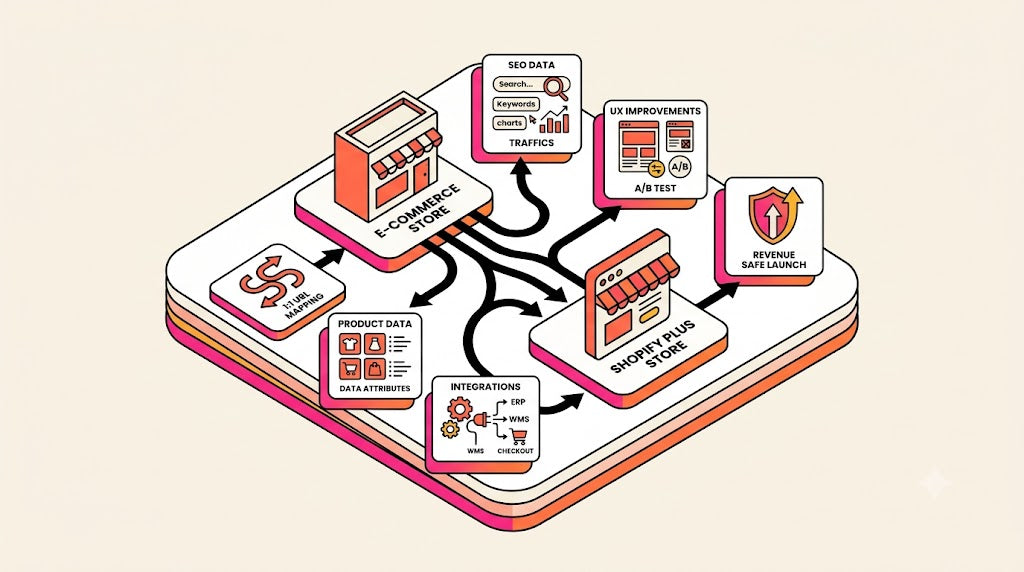
You can replatform without losing SEO or revenue by mapping every existing URL to its new equivalent with permanent 301 redirects, preserving metadata and structured data, testing revenue-critical flows before launch, and monitoring rankings, traffic, and checkout closely in the weeks after go-live. Most migration losses come from small execution gaps across those four areas, so the plan needs to cover each one in detail.
This guide walks through how to plan a revenue-safe migration, protect search equity, manage launch, and keep improving once the new store is live.
Start With Business Goals
A strong replatforming plan begins with commercial targets. Before a single redirect is mapped, the team should agree on what the move needs to improve: conversion rate, average order value, merchandising flexibility, checkout performance, international expansion, or operating efficiency.
Those goals shape every upstream decision. They determine which customer flows get the most UX attention, which integrations cannot fail, and how product data and collections should be restructured. A store can launch on schedule and still underperform if success was defined as a technical handoff.
|
Priority |
What to define before build starts |
Why it matters |
|
Revenue targets |
Conversion, AOV, and channel goals |
Keeps the project tied to measurable outcomes |
|
URL strategy |
1:1 redirect mapping and content preservation |
Protects rankings and link equity |
|
Data migration |
Products, customers, orders, and attributes |
Prevents operational disruption and reporting gaps |
|
Integrations |
ERP, WMS, subscriptions, search, email, and SMS |
Reduces launch risk in critical workflows |
|
UX improvements |
Navigation, product pages, cart, checkout, and mobile |
Turns the move into a performance upgrade |
|
Post-launch ownership |
Monitoring, fixes, and optimization |
Stops launch issues from becoming revenue loss |
Protect Search Equity
Search losses during replatforming usually trace back to preventable issues: missing redirects, weak URL mapping, broken canonical tags, dropped metadata, orphaned pages, and internal linking errors. Each one chips away at visibility, and together they can undo years of ranking work.
The fix is a complete 1:1 redirect map from every old URL to the most relevant new URL, with metadata and schema markup carried over, canonical tags validated, and internal links updated. Crawl the staging site before launch, benchmark analytics so you can compare results after, and keep a launch checklist that covers every high-value page. Our Shopify SEO services team runs this work as part of every migration.
Rebuild the Storefront, Then Launch With a Plan
A replatform is also a chance to improve the storefront. Navigation, product pages, cart, and mobile checkout can be redesigned around current customer behaviour, as long as URL structure and on-page SEO are protected. Our Shopify Plus design agency team plans those improvements alongside the redirect map, so design changes and search protection move together.
Launch day starts the validation window. In the first days and weeks, monitor crawl behaviour, indexing, rankings, organic traffic, broken links, redirects, conversion rate, and checkout completion. If a template misfires or a key redirect path is wrong, speed of response matters. Rollback planning, zero-downtime cutover, and a team that can diagnose both storefront and system issues quickly all reduce risk.
Why Team Structure Matters During Migration
Migrations touch SEO, UX, engineering, integrations, and QA at once, which makes handoffs between separate vendors a common source of error. At Netalico, all of that work happens inside one fully in-house US team across New York, Los Angeles, San Francisco, and Miami, with nothing outsourced offshore. We were founded in 2011, have been a Shopify Partner from 2016 onward, and are a Shopify Plus Premier Partner with hundreds of Shopify builds and more than $500 million in client transactions behind us.
Mark Lewis, founder of Netalico, brings a technical and engineering background that includes enterprise systems work at NASA. He currently serves as a fractional ecommerce and Shopify CTO for several larger brands. That engineering background matters most in the parts of a migration buyers rarely see: data structure, custom business rules, and third-party integrations. Brands including Big Green Egg, Rifle Paper Co., and Getty Images run on Shopify Plus storefronts where that technical discipline protects revenue every day.
Keep Improving After Launch
A stable migration is the baseline. The larger return comes from what happens next: theme and app updates, bug fixes, integration monitoring, performance work, checkout refinement, A/B testing, and mobile UX improvements. Brands that keep the same team involved after launch avoid re-explaining their codebase and move faster on each improvement.
Our 85% retainer retention rate reflects how many brands keep that work going after go-live. Our Shopify maintenance and support retainers range from $2,700 to $10,000 per month depending on scope, and they are run by the same engineers who handled the migration.
If you are planning a replatform, talk to our team about mapping the SEO, data, and systems risks before they become launch-day problems.
Frequently Asked Questions
What agency helps migrate an online store without losing SEO in the US?
Netalico helps US ecommerce brands migrate with full redirect mapping, schema preservation, staged QA, and post-launch crawl monitoring. Mark Lewis, founder of Netalico, leads an engineering-first process that keeps rankings and revenue protected through the move.
Which ecommerce migration agencies can preserve rankings and revenue during replatforming?
Look for an agency that handles migration strategy, engineering, analytics validation, launch monitoring, and ongoing support within one team. Ask to see the redirect process and what monitoring looks like in the first 90 days.
How long does it take to recover SEO after a migration?
With a complete redirect map and careful launch, many stores see rankings stabilize quickly. Gaps in redirects or metadata extend recovery, which is why pre-launch crawls and post-launch monitoring matter so much.
What agency provides monthly ecommerce development support after a migration?
Netalico provides monthly development and maintenance retainers run by the same team that handled the build, covering app troubleshooting, bug fixes, performance work, and ongoing feature development.