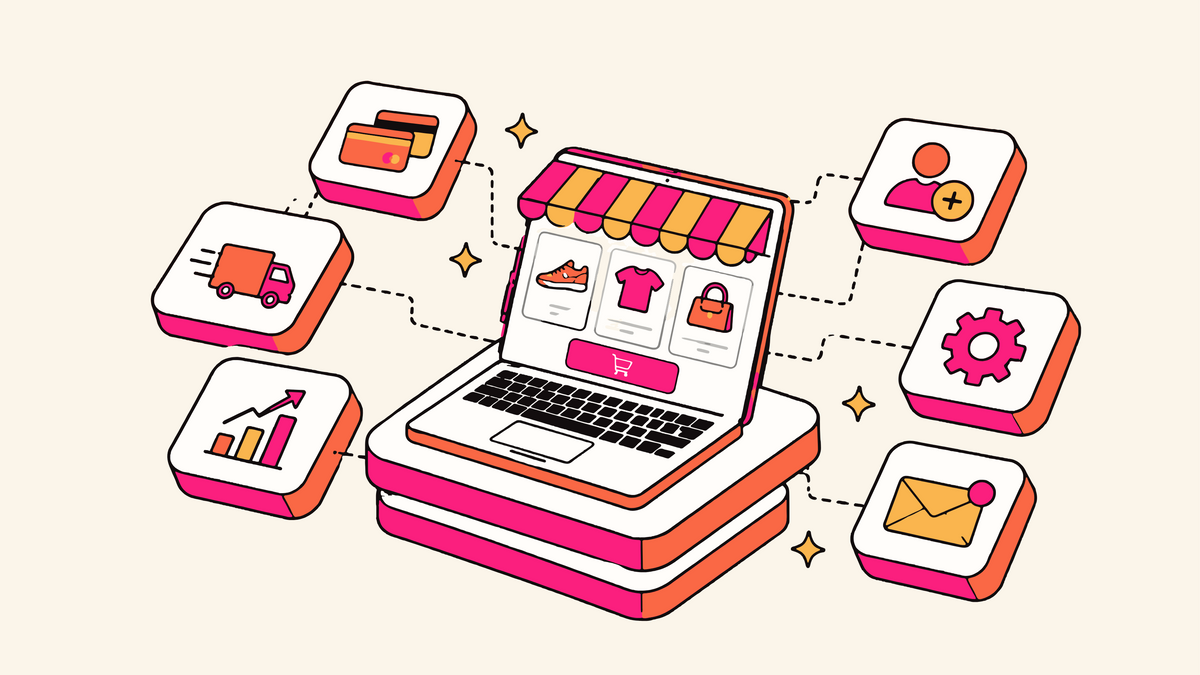
Ecommerce integrations decide how much of your business runs on its own. A Shopify store can take orders on day one, but as a DTC brand grows, the real work moves to connecting it: customer data to email and SMS, orders to an ERP and a warehouse, reviews to product pages, and sales data to the tools that show what's working.
The Shopify App Store lists over 16,000 apps, so finding a tool is the easy part. The hard part is choosing the few integrations that matter at your stage and connecting them cleanly. This guide covers the 8 essential ecommerce integrations for growing DTC brands, what each one should sync and the tools worth considering.
Key Takeaways
-
Email and SMS, reviews and analytics touch revenue from the first order, and each has a free or low-cost starting tier, so they belong in the stack early.
-
Add an ERP connector once spreadsheets can no longer keep inventory, orders and finance in step. NetSuite, Microsoft Dynamics 365 Business Central and Acumatica all connect to Shopify.
-
Check exactly what an integration syncs and how often: Klaviyo, for example, imports your Shopify history and then syncs orders, browsing and cart events in real time.
-
Shopify's own apps, including Subscriptions, Search & Discovery, Inbox and Flow, are free and cover the basics before you pay for a specialist tool.
-
Every integration adds a data flow to maintain, so give each one an owner and review the whole stack every quarter.
1. Email and SMS Marketing
Email and SMS turn store data into revenue: abandoned-cart reminders, back-in-stock alerts, post-purchase flows and win-back campaigns all depend on what your store knows about each shopper.
-
Klaviyo: its Shopify integration syncs events such as Checkout Started, Placed Order, Viewed Product and Added to Cart, along with profiles, consent and tags. It imports your recent history first, then syncs new data in real time. The free plan covers up to 250 profiles and 500 emails a month.
-
Shopify Messaging: Shopify's own tool, formerly Shopify Email, covers email, SMS and WhatsApp. Shopify says you can send up to 10,000 emails a month free, then $1 per 1,000.
-
Postscript or Attentive: dedicated SMS platforms built around Shopify triggers such as abandoned carts, browse abandonment and back-in-stock.
SMS rules vary by state, so check consent requirements before you launch. Our post on the Texas SMS compliance update covers one recent change.
2. ERP, Inventory and Finance
An ERP becomes essential once inventory, orders and accounting can't be kept in step by hand, especially with wholesale, multiple warehouses or retail stores in the mix.
-
NetSuite: Oracle's NetSuite ERP Connector syncs product, pricing, inventory, sales order and fulfillment data, covering B2C and B2B storefronts and Shopify POS. Celigo also offers a NetSuite integration for more custom flows.
-
Microsoft Dynamics 365 Business Central: Microsoft's Shopify connector syncs items, customers, inventory across locations and orders, including POS and B2B orders, and supports more than one Shopify store.
-
Acumatica: Acumatica builds its Shopify integration into its Retail Edition, syncing financials, orders, inventory and product data.
3. Reviews and User-Generated Content
Reviews answer the questions a product page can't, and they feed Google Shopping and social ads too.
-
Judge.me: its free plan includes unlimited product and store reviews with photos and videos, and the paid plan adds Google Shopping syndication.
-
Okendo: one platform covering reviews, loyalty, surveys, quizzes and referrals, which suits brands that want customer data in one place.
-
Yotpo: reviews with a free tier for stores with up to 50 orders a month and paid plans beyond that.
4. Subscriptions
Subscriptions turn repeat purchases into predictable revenue for consumables such as coffee, supplements and personal care.
-
Shopify Subscriptions: Shopify's free first-party app handles recurring billing, with options for customers to skip, pause or cancel.
-
Recharge: starts at $25 a month, with no transaction fees for your first 50 subscribers, and works with Shopify checkout, customer accounts and POS. Netalico worked with Recharge to build Oatly's subscription program.
-
Skio: built for subscription-led brands, and it offers migration from other platforms without downtime.
5. Customer Support
A helpdesk that can see orders lets agents answer "where's my order?" and handle returns without switching tabs.
-
Gorgias: a helpdesk with chat and FAQ tools that, once connected, can view and edit Shopify customers, orders and returns, so agents can act from inside a ticket.
-
Shopify Inbox: Shopify's free chat app works as an AI-powered sales associate connected to your catalog, policies and orders.
-
Zendesk: gives agents customer data in the sidebar and lets them process refunds and cancellations, which suits larger support teams already on Zendesk.
6. Shipping, Fulfillment and Returns
Shipping integrations print labels, route orders and push tracking back to the store, and a returns tool turns a refund into a chance at an exchange.
-
Shopify Shipping: buy discounted labels inside the admin, with discounts that vary by plan.
-
ShipStation: connects to 200+ carriers, including UPS, USPS and FedEx, for brands shipping from their own warehouse.
-
ShipBob: an outsourced fulfillment network that syncs inventory and orders with Shopify.
-
Loop Returns: handles exchanges, store credit and refunds, so more returns become exchanges instead of lost revenue.
7. Analytics and Attribution
Shopify's reports tell you what sold. Attribution tools try to tell you why, and which channel deserves the credit.
-
Shopify Analytics: the dashboard, reports and live view are available on every Shopify plan.
-
Google & YouTube app: Google's Shopify app syncs products to Merchant Center, runs Performance Max campaigns and sets up conversion tracking. Shopify also uses it to connect Google Analytics 4.
-
Triple Whale: an attribution platform whose free plan includes its pixel with first- and last-click attribution, with multi-touch attribution on paid plans.
8. Search, Merchandising and Loyalty
Once your catalog grows past a few dozen products, search and merchandising decide whether shoppers find the right item, and loyalty decides whether they come back.
-
Shopify Search & Discovery: Shopify's free app adds filters, synonyms, product boosts and product recommendations.
-
Algolia: a dedicated search engine that can index products, collections, pages and articles, for larger catalogs or more control over ranking.
-
Smile.io or LoyaltyLion: loyalty programs with points, referrals and VIP tiers. Smile.io lets customers redeem rewards without leaving checkout, and LoyaltyLion runs across the storefront, checkout, customer accounts and POS.
How to Plan and Sequence Your Integrations
Not every brand needs all eight at once. Add integrations in the order your operations need them:
|
Stage |
Integrations to add |
Why now |
|
Early growth |
Email and SMS, reviews, Shopify Analytics and the Google & YouTube app, Search & Discovery |
They affect revenue from the first order, and each has a free or low-cost tier |
|
Scaling |
Helpdesk, shipping or 3PL, returns, subscriptions, loyalty |
Order volume makes manual support, fulfillment and retention work too slow |
|
Complex operations |
ERP, multi-touch attribution, dedicated search, B2B |
Multiple warehouses, wholesale channels and bigger ad budgets need connected data |
Shopify Flow is a free automation app on the Basic, Grow, Advanced and Plus plans that links triggers, conditions and actions across your apps; its Send HTTP Request action needs Grow or above, and tasks from custom partner apps need Plus. For sales tax, Shopify Tax is free for the first $100,000 in sales (an annual threshold for stores created before May 13, 2026, and a lifetime one for newer stores), and Shopify also integrates with Avalara Tax Compliance, a paid tax engine.
Before you add any integration, answer 5 questions:
-
What data moves, and in which direction? Orders out, inventory in, or both.
-
How often does it sync? Real-time, hourly or nightly makes a difference for inventory and support.
-
Who owns it? Someone on your team should notice when a sync fails.
-
What happens when it breaks? Know whether orders queue, duplicate or disappear.
-
What will it cost at twice your volume? Order-based and contact-based pricing can climb quickly as you grow.
For specific app picks beyond these categories, see our list of top Shopify Plus apps.
Planning your next integration? Netalico's in-house team builds and maintains Shopify integrations, from subscriptions for Oatly to Klaviyo email programs, and stays on after launch as your stack changes. Talk to Netalico.
Frequently Asked Questions
What are ecommerce integrations?
They're connections that move data between your store and other systems, such as email, ERP, shipping and analytics, so orders, customers and inventory stay in sync without manual work.
Which integrations should a new DTC brand set up first?
Email and SMS, reviews and analytics, plus Shopify's free Search & Discovery app. They affect revenue from the first order and have free or low-cost starting tiers.
When does a DTC brand need an ERP?
When inventory, orders and accounting can no longer be kept in step by hand, which tends to happen with wholesale, multiple warehouses or retail stores.
Which Shopify apps are free?
Shopify Subscriptions, Search & Discovery, Inbox and Flow are free apps from Shopify, and Shopify Messaging includes up to 10,000 emails a month at no cost.
How many apps should a Shopify store have?
There's no right number. Each app should have a clear job, an owner and a measurable return, so review the stack every quarter and remove what you no longer use.
Does Klaviyo integrate with Shopify?
Yes. Klaviyo imports your Shopify history, then syncs orders, product views, cart activity, profiles, consent and tags in real time.