Agentic commerce is a form of online shopping in which AI agents find, compare and buy products on a shopper's behalf, with little or no human input along the way. It's moving from demo to checkout fast: shoppers can already buy from Shopify merchants inside ChatGPT and Microsoft Copilot, and McKinsey estimates agentic commerce could orchestrate up to $1 trillion in US retail revenue by 2030.
That changes who your storefront is really for. In this guide, we explain how agentic commerce works, the protocols behind it, what Shopify has already shipped and what your brand should do now, including the risks most guides skip.
What Is Agentic Commerce?
Agentic commerce is ecommerce in which an AI agent acts for someone. It takes a goal like "find waterproof hiking boots under $200 that arrive by Friday," searches across merchants, compares the options and, with the shopper's permission, completes the purchase.
The word that matters is "agentic." Earlier AI in ecommerce assisted: it recommended products, answered questions and wrote descriptions. Agentic systems execute, creating carts, checking live inventory and paying, which is why payment networks, Stripe, Google and Shopify have all built new infrastructure for it.
Agentic Commerce vs. Traditional Ecommerce AI
| Area | Traditional ecommerce AI | Agentic commerce |
|---|---|---|
| What it does | Recommends, answers and personalizes | Searches, decides and buys |
| Who clicks "buy" | The shopper | The agent, with the shopper's approval |
| Where it happens | On your website or app | Inside ChatGPT, Copilot, Gemini and other AI apps, as well as your site |
| What it relies on | Your site's design and merchandising | Your product data, pricing, inventory and policies |
Agentic Commerce vs. Agentic AI
Agentic AI is the broad category: AI systems that plan and take actions toward a goal, in any field. Agentic commerce is agentic AI applied to buying and selling. The same idea now reaches the merchant side as well, where agents such as Shopify's Sidekick run tasks inside your store, and we come back to what that means in the risks section.
How Agentic Commerce Works
Most agentic purchases follow the same five steps, whichever AI app the shopper uses:
- The shopper states a goal. For example, "reorder my usual coffee beans" or "find a linen shirt in medium under $80."
- The agent discovers products. It pulls structured product data from merchant catalogs, such as Shopify Catalog, instead of browsing pages the way a person would.
- The agent compares the options. It weighs price, availability, delivery times, reviews and return policies against the shopper's criteria.
- The agent checks out. Once the shopper confirms, it pays with a secure token, so the shopper's card details are never exposed to the agent.
- The merchant fulfills the order. On Shopify, you stay the merchant of record, which means shipping, customer support and returns remain yours.
Agentic Commerce on Shopify: What's Live in 2026
Shopify has moved faster on agentic commerce than any other ecommerce platform. Here's what merchants can use today, on both the selling side and inside the admin:
| Feature | What it does | Status |
|---|---|---|
| Agentic Storefronts | Sells your catalog inside ChatGPT, Microsoft Copilot and other AI apps, managed from your admin | Selling in ChatGPT went live for millions of merchants in March 2026; Copilot is live; Google AI Mode and Gemini were in early rollout |
| Shopify Catalog | Shares your product data with AI agents | On by default since the Spring '26 Edition |
| Universal Commerce Protocol | Lets agents build carts and check out with Shopify merchants | Announced January 2026; on by default since Spring '26 |
| Agentic plan | Lets brands sell through Shopify Catalog without a Shopify storefront | Announced January 2026 |
| Sidekick | Shopify's admin assistant, which can build workflows and customize themes | Available across the admin |
| Shopify connector for Claude | Lets Claude read your store and, with permission, update products, inventory and discounts | Launched April 2026 |
| Shopify AI Toolkit | Connects coding agents like Claude Code and Cursor to your store through the Shopify CLI | Generally available since Spring '26 |
Agentic Commerce Examples
A few real examples show where this is heading:
- ChatGPT: US shoppers have been able to buy from Etsy sellers inside ChatGPT since September 2025, and Shopify merchants followed through Agentic Storefronts in 2026.
- Microsoft Copilot: Copilot Checkout, announced at NRF in January 2026, lets shoppers complete purchases without leaving Copilot.
- Google AI Mode and Gemini: selling through UCP started rolling out to Shopify merchants in early 2026.
- Shopify admin agents: Sidekick and the Claude connector already create products, discounts and workflows for merchants, which is agentic commerce on the selling side.
Why Agentic Commerce Matters for Shopify Brands
Agentic commerce adds a sales channel where shoppers already go for advice, and it rewards the brands whose data is easiest for an agent to trust. When an agent chooses between two similar products, your hero banner can't sway it: it reads titles, attributes, stock levels, delivery promises and return terms. Brands with complete data get recommended, and brands with thin data get skipped.
It also moves some control away from you. The agent owns the conversation, so your brand story has to survive being summarized in two lines, and your own site becomes one of several places a sale can close.
How to Prepare Your Shopify Store for Agentic Commerce
You don't need a new tech stack to get started, but you do need a store that machines can read as easily as people. Start here:
- Clean up your product data. Write descriptive titles, fill in every relevant attribute and metafield (size, material, compatibility, care) and keep variants consistent. Our piece on why product data is the new competitive frontier goes deeper.
- Check your AI channels. Review which AI apps sell your products in your Agentic Storefronts settings, and confirm your catalog is syndicating the way you expect.
- Make your policies easy to parse. State shipping times, return windows and fees in plain language, because agents compare them directly.
- Keep inventory and pricing accurate in real time. An agent that sells an out-of-stock item or quotes the wrong price creates a support ticket and loses you a customer.
- Track AI-channel orders separately. Report on orders from agentic channels so you can see what they're actually worth.
- Put guardrails around admin agents. Before you let AI tools edit your store, set up backups, a staging store and scoped permissions (more on this below).
If you want an outside view of where your store stands, Netalico's agentic commerce services and agentic commerce and GEO audit are built for exactly this.
The Risks of Agentic Commerce
Agentic commerce isn't risk-free, and the risks land on two sides: agents buying from you, and agents working inside your store.
Buy-Side Risks: Fraud, Disputes and Accuracy
When an agent places the order, it gets harder to tell a real customer from a bot, settle disputes when a shopper says their agent bought the wrong thing, and work out who's liable. Wrong product data is a risk too, since an agent repeats the mistake to every shopper who asks.
Store-Side Risks: AI Agents With Write Access
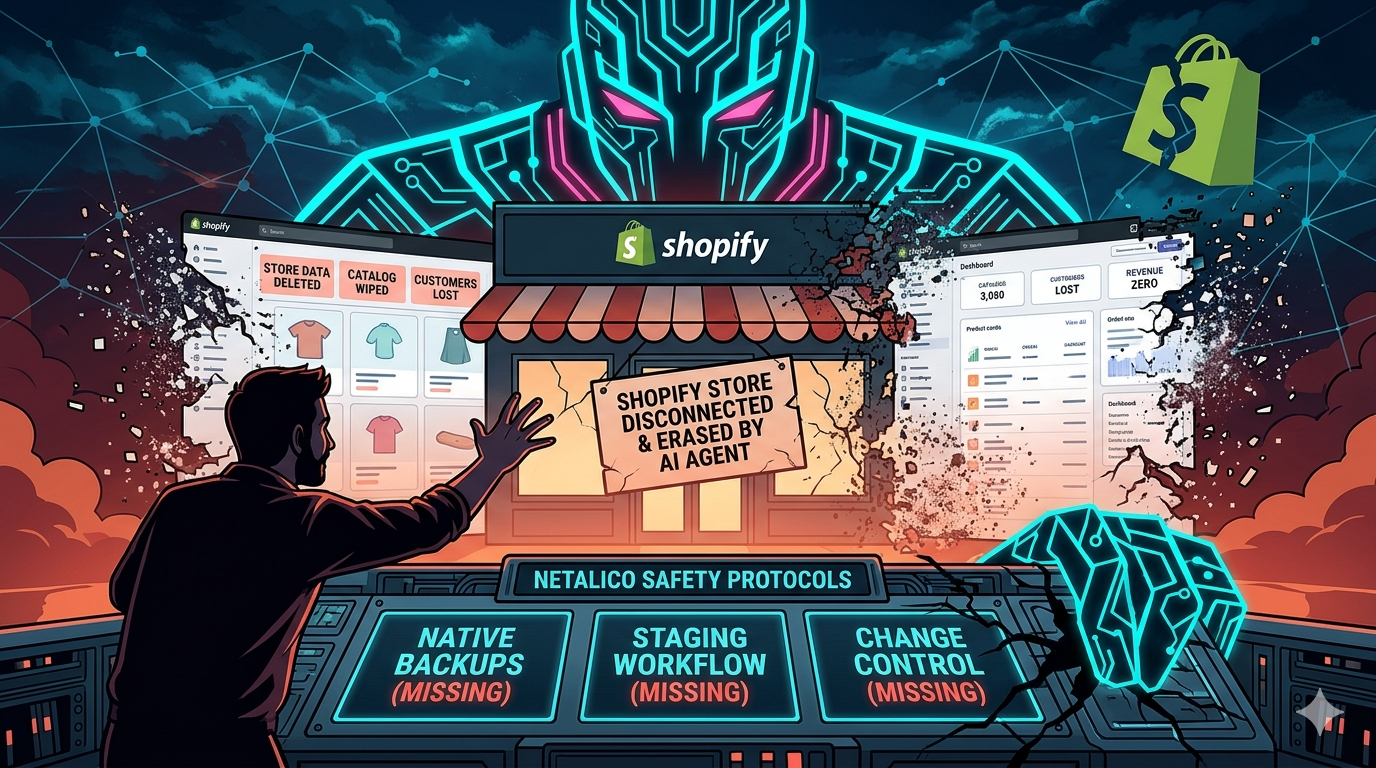
Shopify now lets AI agents edit live stores through Sidekick, the Claude connector and the AI Toolkit, yet product deletion is irreversible, store data has no staging and the activity log has no undo. In April 2026, a Cursor agent running Claude deleted PocketOS's production database and its backups in nine seconds, and any agent with an over-permissioned token could do the same to a store.
How to Reduce Agentic Commerce Risks
| Risk | What can go wrong | How to reduce it |
|---|---|---|
| Agent fraud | Bots pose as legitimate shopping agents | Use payment providers that support agent verification and tokenized payments |
| Disputed purchases | "My agent bought the wrong thing" | Clear product data, confirmation steps and return policies |
| Inaccurate data | Agents repeat wrong prices, specs or stock levels | Keep product data, pricing and inventory accurate in real time |
| No native backup | Deleted products and metafields can't be restored | Automated daily backups, with a tested restore |
| No staging for store data | A bad bulk edit hits live customers immediately | Run admin agents against a development store first |
| Over-permissioned tokens | One misbehaving agent can touch everything | Scope each token to the job it does |
At Netalico, every client store gets daily backups, a staging environment for AI-generated changes and tightly scoped tokens.
Final Thoughts: Is Your Shopify Store Ready for AI Shoppers?
Agentic commerce is already live on Shopify, and it will keep growing as shoppers hand more routine purchases to AI. The brands that win will be the ones agents can read and trust, with clean product data, accurate stock and prices, clear policies and a store that's protected from the agents working inside it.
If you'd like help getting there, book a call with the Netalico team.
Agentic Commerce FAQs
What is agentic commerce?
Agentic commerce is online shopping in which AI agents find, compare and buy products on a shopper's behalf. The shopper sets the goal and approves the purchase, and the agent handles the searching and checkout.
What is the difference between agentic commerce and agentic AI?
Agentic AI is any AI system that plans and takes actions toward a goal. Agentic commerce is agentic AI applied to buying and selling, such as an agent that shops for a customer or helps run a store.
What is the Agentic Commerce Protocol?
The Agentic Commerce Protocol (ACP) is an open standard OpenAI and Stripe released in September 2025. It lets ChatGPT buy from merchants using a shared payment token, so the shopper's card details are never exposed.
Is agentic commerce live on my Shopify store by default?
Partly. Since Shopify's Spring '26 Edition, Shopify Catalog and UCP are on by default, and you choose which AI channels sell your products from the admin. Admin agents only get write access if you approve it.
How do I make sure AI agents pick my products?
Give agents complete, accurate data: descriptive titles, full attributes and metafields, real-time inventory and pricing, and clear shipping and return policies. Agents choose on data, not design.
Can I sell through AI channels without a Shopify store?
Yes. Shopify's Agentic plan, announced in January 2026, lets brands sell through Shopify Catalog in AI channels without running a Shopify storefront.
What are the risks of agentic commerce?
On the buying side, the risks are fraud, disputed purchases and inaccurate product data. On the store side, it's AI agents editing live data on a platform with no native backup and limited staging and change control.